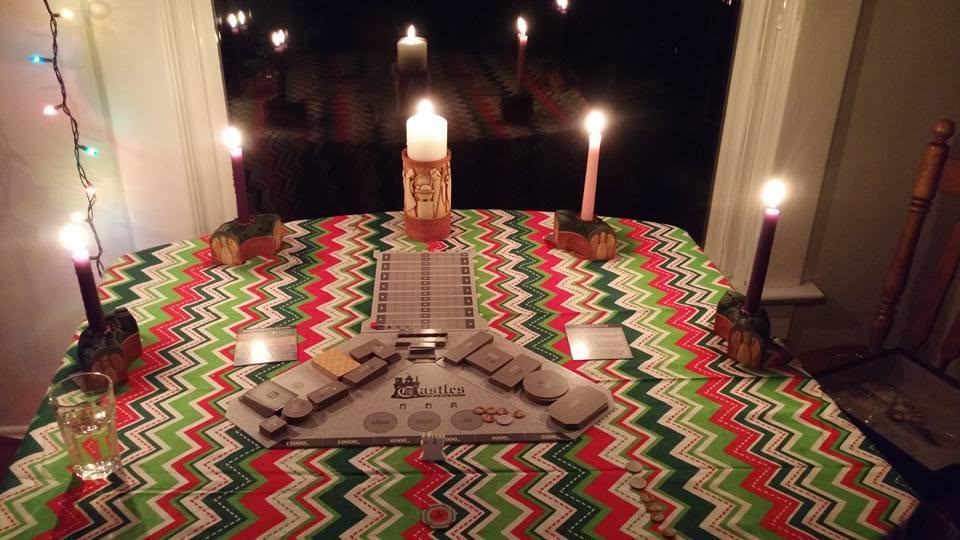
With that song stuck in your head let’s talk talk about a phenomenal game of interior design and market manipulation. Castles of Mad King Ludwig has players fighting over parlors and dungeons to make their own personal fortress of not-quite-solitude for fun and points. When I first moved back to Ohio and hadn’t made friends in the gaming scene, I spent many quiet hours playing this game by myself. The above pictured shrine to my loneliness is testament to this strange period and the game that got me through it.
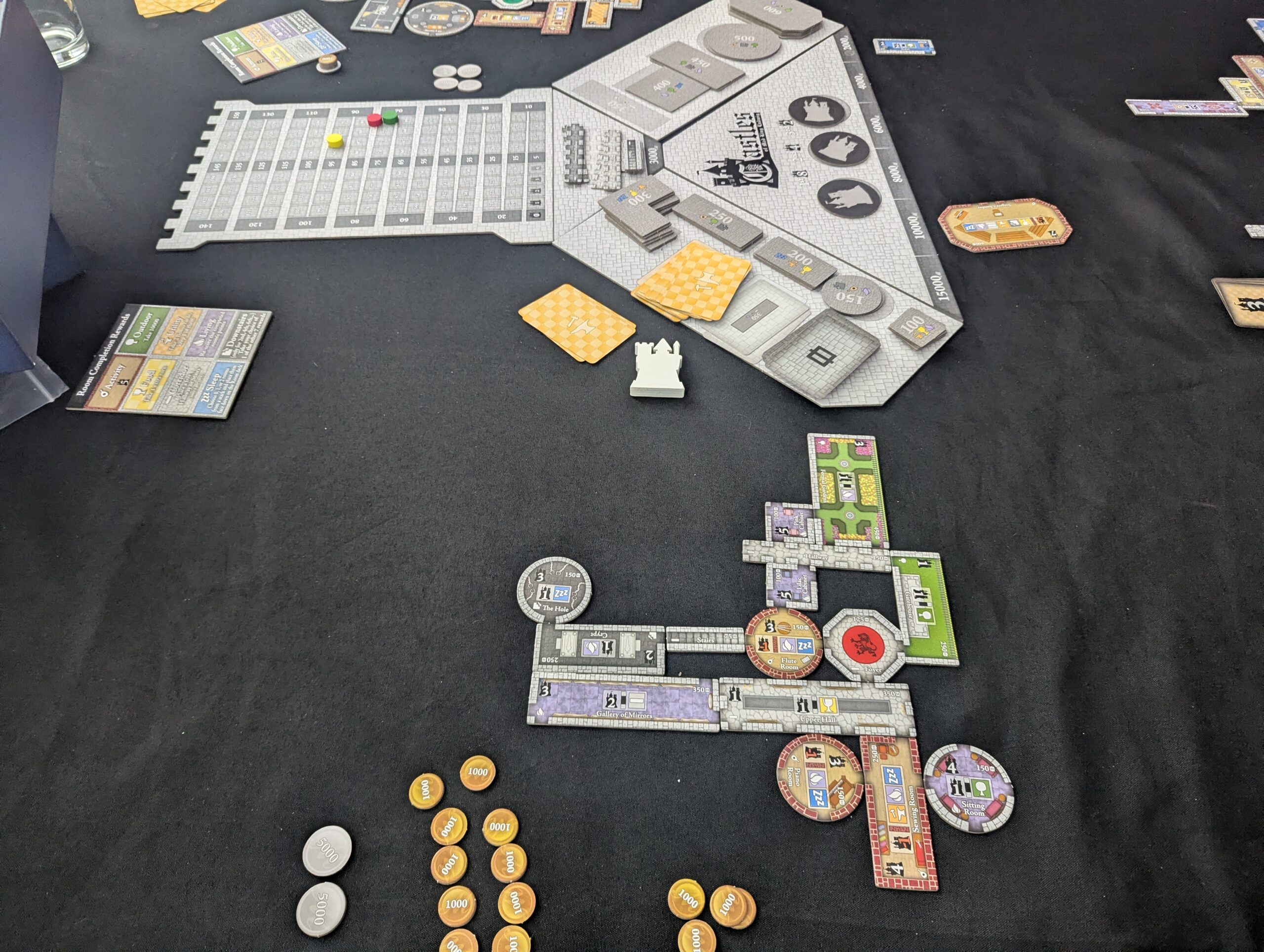
In Castles you are designing sumptuous structures by purchasing the available rooms and slotting them into your ever-growing stonework amoeba. All players begin the game with a humble foyer, a wad of cash, and some secret scoring objectives. Maybe you want to fill your castle with kitchens or with circular rooms; either can be a path to sweet sweet victory points at the end of the game. In addition to these hidden goals, the king will have some public objectives it behooves you to chase after. These can be specific shapes or types of rooms and they’ll provide you and your architectural competitors with an open challenge you can fight over or ignore in favor of less obvious paths to victory. Every room is worth points and many rooms provide a bonus or penalty for being next to other types of rooms so configuring the right placement is key.
Every round, one player will act as a chief architect and will determine the price of the available rooms. The other players will go around choosing whether to purchase these rooms or pass for cash. Any money they spend this round goes to the chief architect and is the primary way of earning money which creates a fantastic crux of player interaction. The architect wants to both maximize how much money they’ll have to spend not only on their turn but on other players’ turns but they also want to make sure they’re not overpricing things so much that players choose to just pass for cash. As for the other players they might have the money to buy high scoring rooms but are going to be wary of handing huge wads of cash to this conniving rival so might forego an expensive, optimal room for a so-so cheaper one. In a game that largely consists of bending over your little castle floorplan rotating pieces to fit just so, this mechanic does a phenomenal job of creating tension and conflict.
As rooms go down, doorways open up to allow for the castle to spread in different directions. These doorways can be bricked up by a wall but if a room manages to have all their doors successfully used then it unlocks an extra bonus depending on the room type. Gardens provide cash, kitches give you an extra turn, living rooms shoot out extra points, etc. Weighing the value of chasing these bonuses vs the flexibility of placing a room so it fits just so is another juicy puzzle this game provides. As castellans have known for centures, corridor management is a key skill.
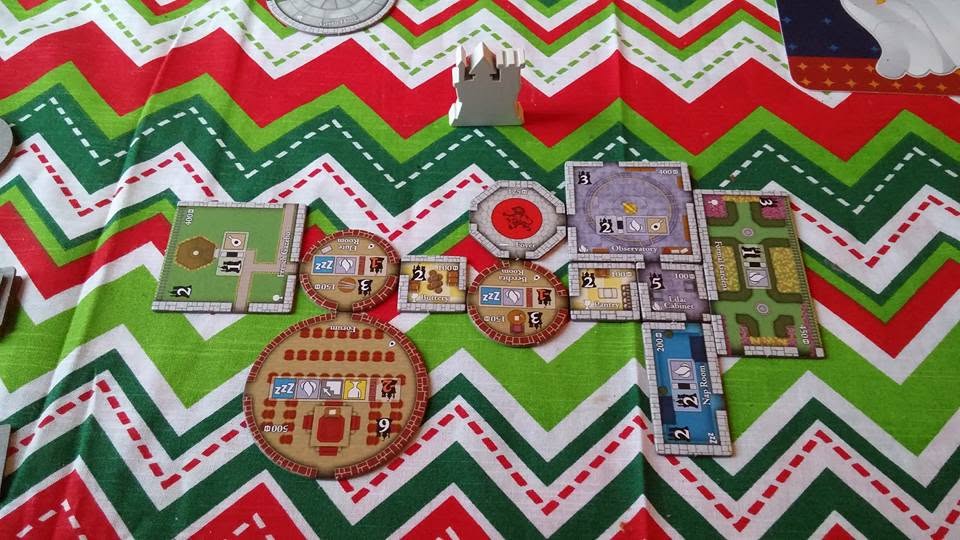
Once all the rooms are down and the game is over, players score and determine victory but more importantly take a moment to look at the bizarre castles they’ve provided for imagined teutonic aristocrats. Is there anywhere to sleep? Is it largely a warren of sub-basements? The mind boggles at the logistics but a canny dungeon master could take notes and provide a truly memorable dungeon delving adventure for their friends. Truly a game that keeps on giving.
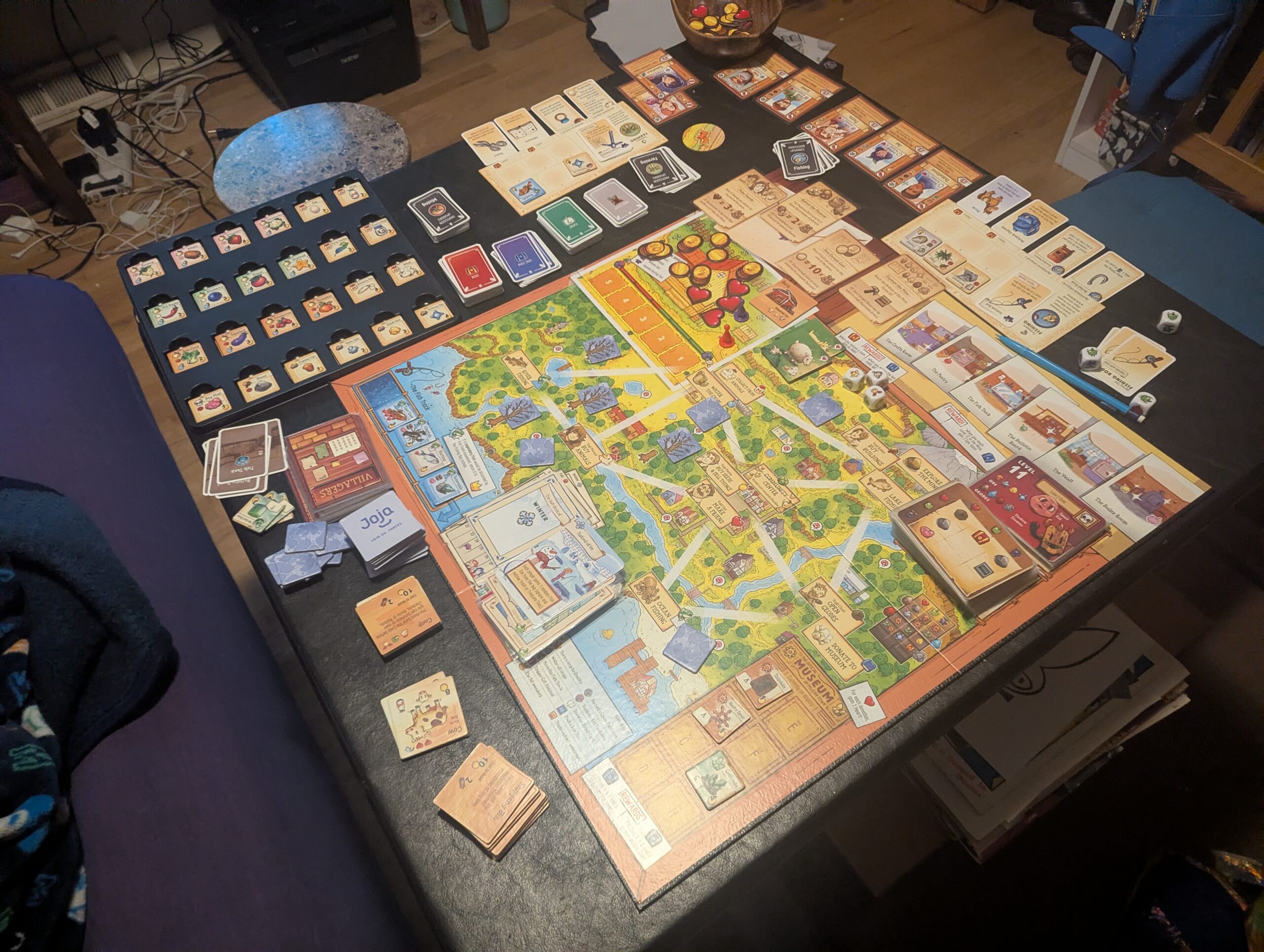
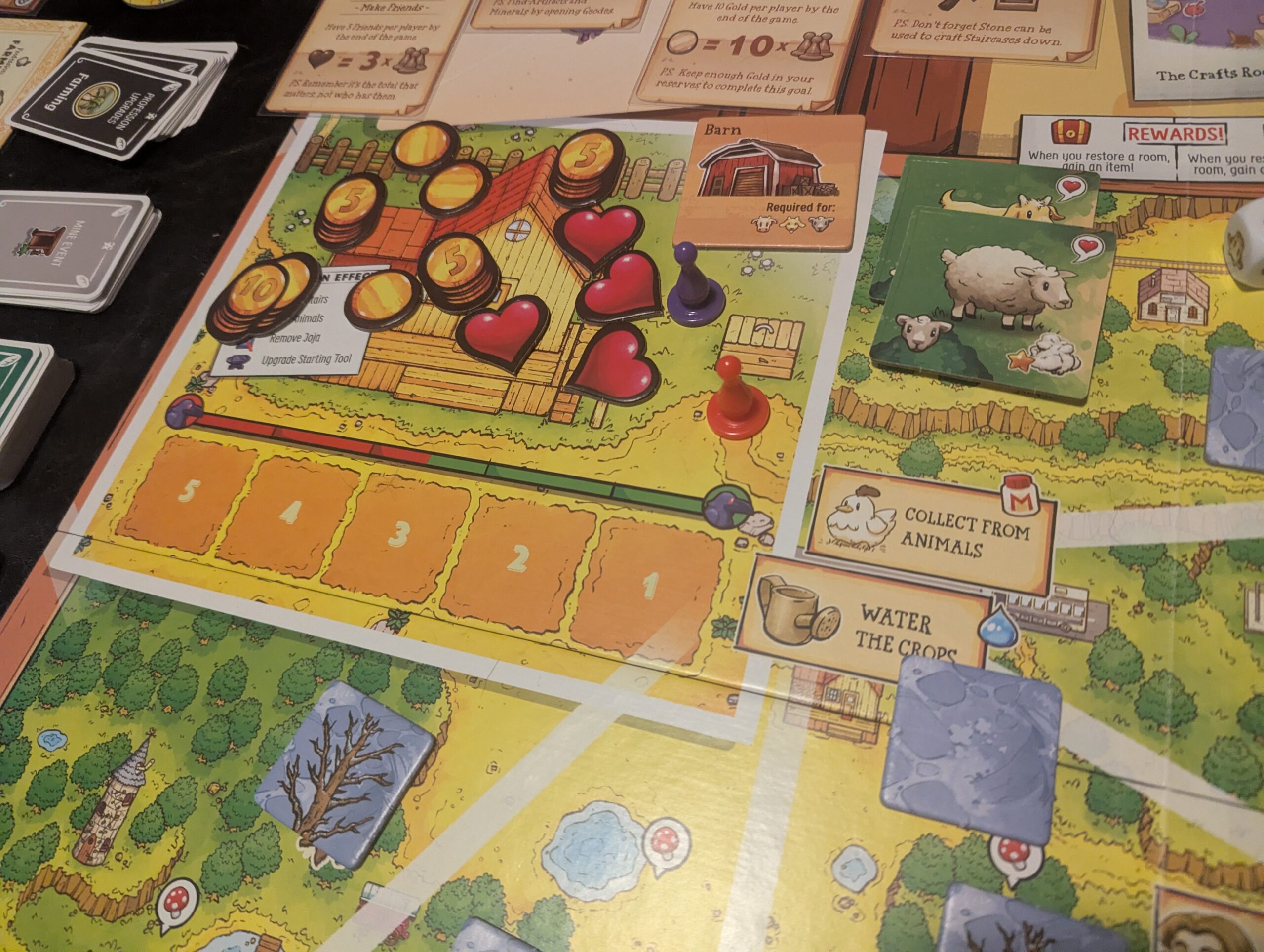
Stardew Valley has long been a warm cozy videogaming experience for me and so it was gratifying when both of my kids took to the game even if it does lead to occasional Camp David-esque negotations about whose turn it is with the iPad. Thus I was delighted and/or confused to find there was a board game adapatation and wondered if perhaps this might be a way for us all to collectively experience the game on less fraught terms. The reality is we changed one set of stressors for another although not in altogether unpleasant ways.
It’s a solo or cooperative game where you have one calendar year made up of 16 days/rounds in which to accomplish anywhere from 4 to 11 goals depending on the difficulty setting you choose. The easiest victory just involves accomplishing 4 tasks set by your grandfather. At medium difficulty you also need to unlock and fulfill all 6 community center bundles. The hardest challenge involves ending the game with all these goals accomplished while also getting rid of any JoJa Mart penalties.These goals largely revolve around collecting the various pastoral or mineral resources, accumulating wealth or friendship, improving yourself or your farm, and delving. All these activities are familiar to longtime Stardew Valley players with a key difference of the time limit looming over your every move. A year can go by very quickly, particularly when you waste it gambling on the wrong fish or bashing your head against bats in a cave.
At the start of the game, players choose a profession – Farmer, Miner, Forager, or Fisher and then takea starting tool – Hoe, Fishing Pole, Pickaxe, or Watering Can. These provide bonuses for various taks throughout the game. Players can mix and match or double down. After that the most crucial decision is whether to make the Starting Player piece a kitty cat or a puppy dog.
The year is divided into 4 seasons of 4 days each represented by a card. At the start of every round/day players draw a card and either have a festival with its own special rules or trigger a series of good and bad events such as crop advancing rain, crop devouring crows, adding new fish, JoJa Mart messing everything up, or being able to sell off goods for much needed cash. After resolving the card, players can then plan their day by swapping items and resources and then moving their piece to one of the many different areas on the map depending on what they want to do. They are limited to two actions with the option to move once to a new area so planning is vital. All the various actions are interlinked and so timing is crucial. You can’t water crops until you buy seeds or collect milk and wool unless you buy animals or donate to the museum until you’ve delved in the cave. Moving from space to space also allows players to harvest seasonal foraging resources which is one of the few ways to get wood which is needed for buying new buildings which is the only way to get animals and so on and so on.
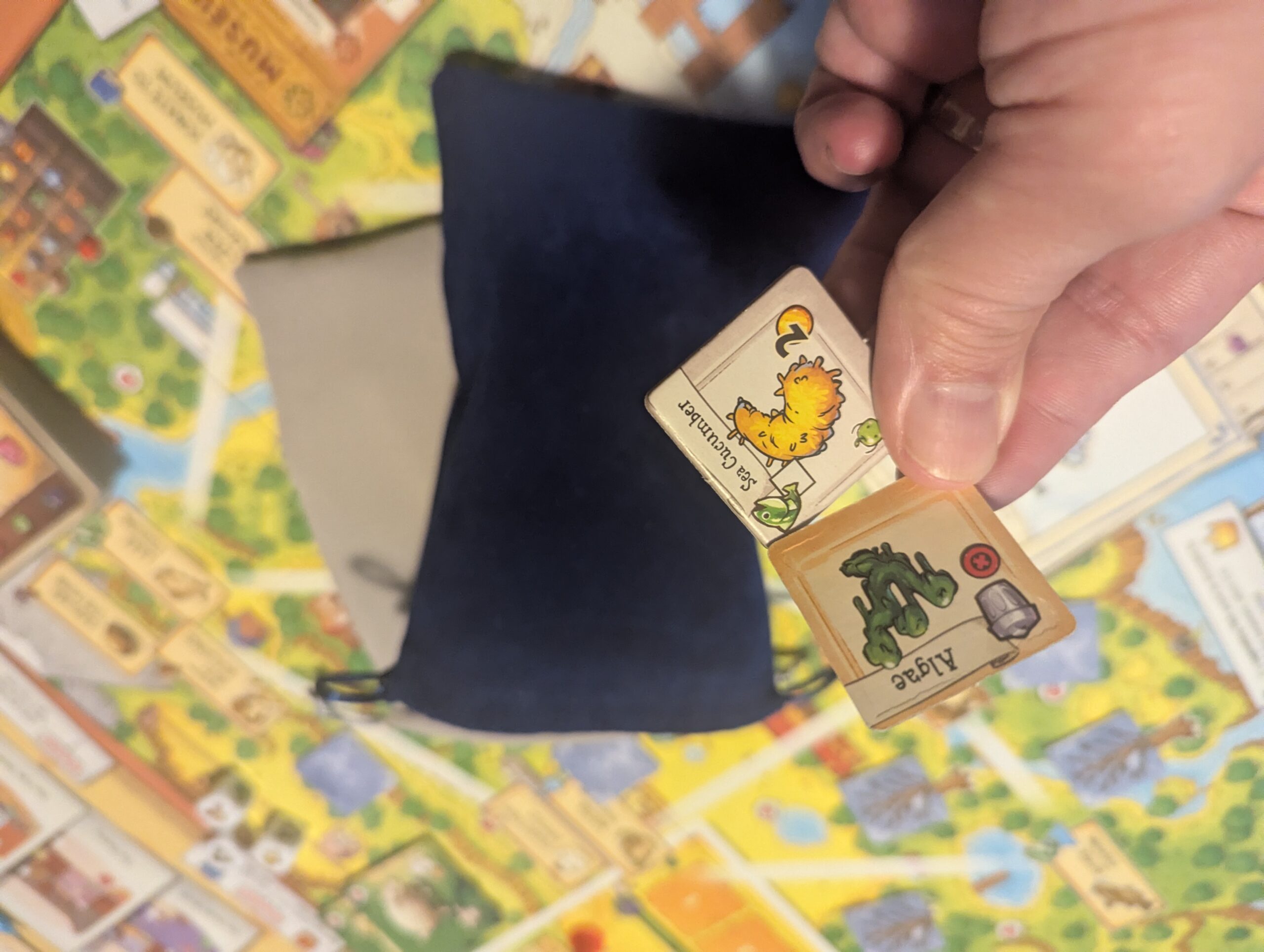
Some of these actions are vital for achieving the winning conditions of the game, others are just useful ways to collect the resources to help you along the way. Figuring out the efficient ways to take these actions and in what order is crucial. If you keep bopping to the museum to drop off artifacts one at a time you’ll quickly run out of time but if you try to hoard up a bunch of items to do one big mega-dump you’ll run out of inventory space and wind up discarding stuff you might need. Some of the actions bring their own mini-game such as fishing, delving, or harvesting from animals. A lot of the actions are pure randomness. Take making friends: it’s one of the few ways to get hearts which are needed for knowing what community center bundles you need to be working on but each time you take the action you randomly draw from a deck, not knowing if your pocketful of gift fish will be acceptable or reviled by the recipient. Mining and fishing also involve both rolling dice and reaching into bags and praying to pull out something useful. If you’ve had the misfortune of drawing JoJa cards, your tasks will be all the harder to accomplish
After taking their two actions, players return to the farm and can then take special end of the day actions such as trading rocks to build staircases to move more quickly through the mines. discarding hearts to pet animals to make them squirt out quality goods, bribing JoJa to go away, or upgrading tools. Once everyone has done what they can, a new card is drawn and a new day’s work begins. Between seasons, forageables are swapped out and players get to draw profession upgrade cards to make their tasks a little easier. If final day of winter passes the game ends and players check to see if they have accomplished all they set out for.
As cooperative games go, this is a pretty intense one. The cuteness to harshness factor goes pretty hard and given how random things are, setbacks can feel arbitrary and frustrating. The game provides some abilities to change out some of the goals and bundles but you can still wind up in situations where you don’t know that you need to collect spring produce for the community center bundle until after that bundle has been revealed and spring is passed. I keep feeling like I need just one or two more days to accomplish everything which possibly speaks to how tightly they’ve made the game but often things just feel more frustrating than fun and planning feels more like paranoia than cleverness. Still it’s an interesting way to experience the familiar Stardew Valley setting and themes and when you do just narrowly accomplish things it can feel quite satisfying.
I increasingly own more and more games about finding homes for cute animals. Everdell was one of my first if it was less realistic and more Redwall. Cascadia and Harmonies both were fun puzzles about appropriate habit development. Last month’s Ark Nova is also mostly about building a zoo and filling it with marketable critters. Forest Shuffle stands out in a handful of ways, from its quiet charm to the rhythm of play. Let’s set off on our arboreal adventure.
In Forest Shuffle players will take turns either drawing cards or playing cards out of their hands. First they’ll need to play trees into their tableau and then they’ll need to play animals and underbrush into those trees. Everything sprouts points and depending on what you’ve played and where you can end the game with a massive ecosystem of points.
Turns are very simple as you alternate between either drawing or playing. The cost to play cards (trees, animals, what have you) are the cards from your hands which get placed in a communal area in the middle of the play area. When you draw cards, you can draw unseen from the deck or you can draw from this communal area. This means that it’s very likely you’ll discard one card on a turn and then draw that card back a few turns later. The trick is to not give up cards your rival foresters want. If there are every ten or more cards in the communal area then all the cards get discarded. Cards will also sometimes have a bonus which you can trigger by paying only with cards that have a matching symbol. The symbols are only used for this and for scoring. Even if an animal has an oak or sycamore symbol it can be played to any tree.
At first you start with a blank canvass and will need to plant trees. There are eight varieties and each one scores differently and comes with different abilities. Some trees are worth a set amount per tree, some reward you by planting more of their own kind, others want varieties of trees in their forest, and so on. A few trees score based on how many you have compared to other players so keep an eye out on how their forest is growing. Trees start empty and can hold four (or more) cards. If you need a free generic tree, you can flip any card over and play it with its back up.
The critters and undergrowth are the real heart of the game and the different strategies and synergies they’ll offer will direct much of your strategy. Every non-tree card is split in half either left-right or top-down and when you play them you have to make the decision of which you’ll play and which you’ll hide under the tree card. Collecting sets of butterflies or stockpiling rabbits can be just as profitable as filling your woods with foxes and deer. Mushrooms often don’t offer up points but can supercharge your engine by letting you draw or play extra cards.
The game ends when you draw the third winter card that was randomly shuffled in at the start of the game, giving you an impending sense of finality with every winter card drawn without ever making it known exactly when the game will end. During scoring, you’ll score your trees, your left-right cards, and then your top-down cards. One last little sneaky scoring area is your cave which bears and raccoons allow you to stash cards in and score at the end of the game. Points can crank up incredibly high as you find all sorts of hidden nooks and crannies where points have been flourishing. Each forest always looks very different and the end-game is a fun surprise as you look over and see just what your fellow players have been up to while you’ve been working.
Forest Shuffle feels very gentle and pleasant as you set up your trees and start sliding different life into them watching them come to life. Cards have continuous impact throughout the game so everything always feels very alive and interactive rather than just being played, scored, and forgotten about. You are constructing a living ecosystem and paying attention to how its growing can be very rewarding. I thoroughly enjoy the quick decisions and ease of play this game offers. The comunal area is particularly engaging as giving up cards doesn’t feel as wasteful as just dumping them in a discard pile never to be seen again. Maybe you’ll recycle that butterfly back into your forest. Maybe one of your rivals will scoop up that Linden you’re thinking of paying to get the goshawk you’ve been prepping to feed a bunch of birds for several turns now. Every decision feels meaningful and long-lived while seldom feeling like you’ve screwed yourself over. I highly recommend it.
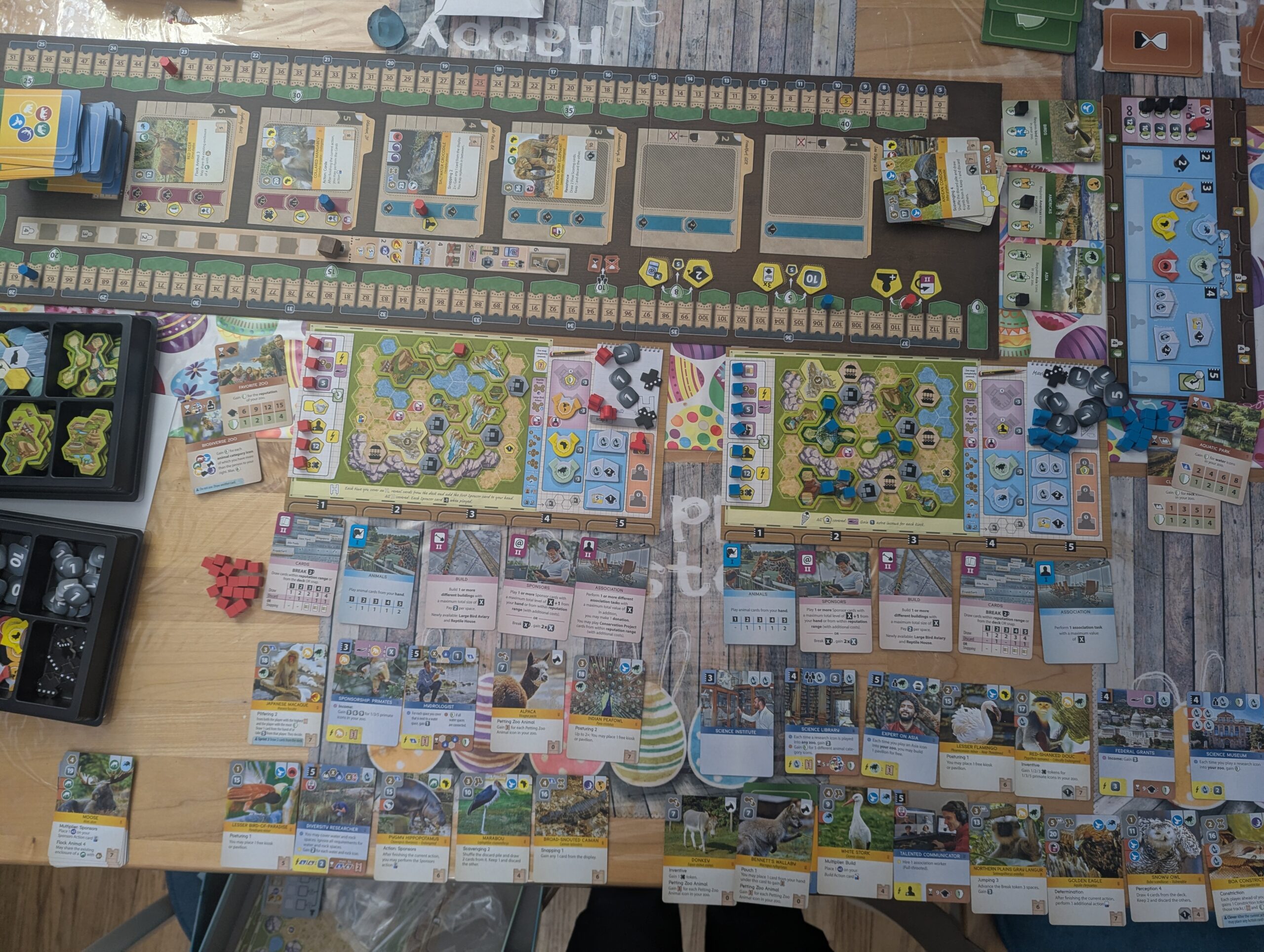
We bought a zoo! Well, we bought a game that simulates the administrative snarl that I imagine owning and operating a zoo to be like but I stand by the cinematic sentiment. When I first opened up this heavy box and saw the menagerie of carboard on display I’ll confess to no small amount of dizziness. As the above picture shows, this game is busy and bustling with at least three boards, two score trackers that run in opposite directions, and many many cuddly critters. Lets put on our emotional sunscreen and try not to get lost in the dizzying paths of Ark Nova.
In Ark Nova players are rival zoos trying to fill up their personal map with enclosures, money-making kiosks, dazzling pavilions, and perhaps a few special exhibits. Into the enclosures will be dropped animals of various shapes, sizes, and predetermined crowd appeal. Zoos are not just about drawing in visitors and selling merchandise but also about ecological education and contributing to conservation efforts. These two goals are rewarded with the aforementioned dual score trackers. Running counterclockwise along the main shared board is your zoo’s appeal is boosted by adding animals and features and coincidentally translates to income in a move that might seem familiar to Terraforming Mars players1. On the opposite side and running clockwise is your ecological score which you improve mostly through conservation efforts. The game ends when both of one player’s score trackers cross like so many ghostbusting beams. At the end of the game, the player who was the greatest positive distance between these two scores wins.
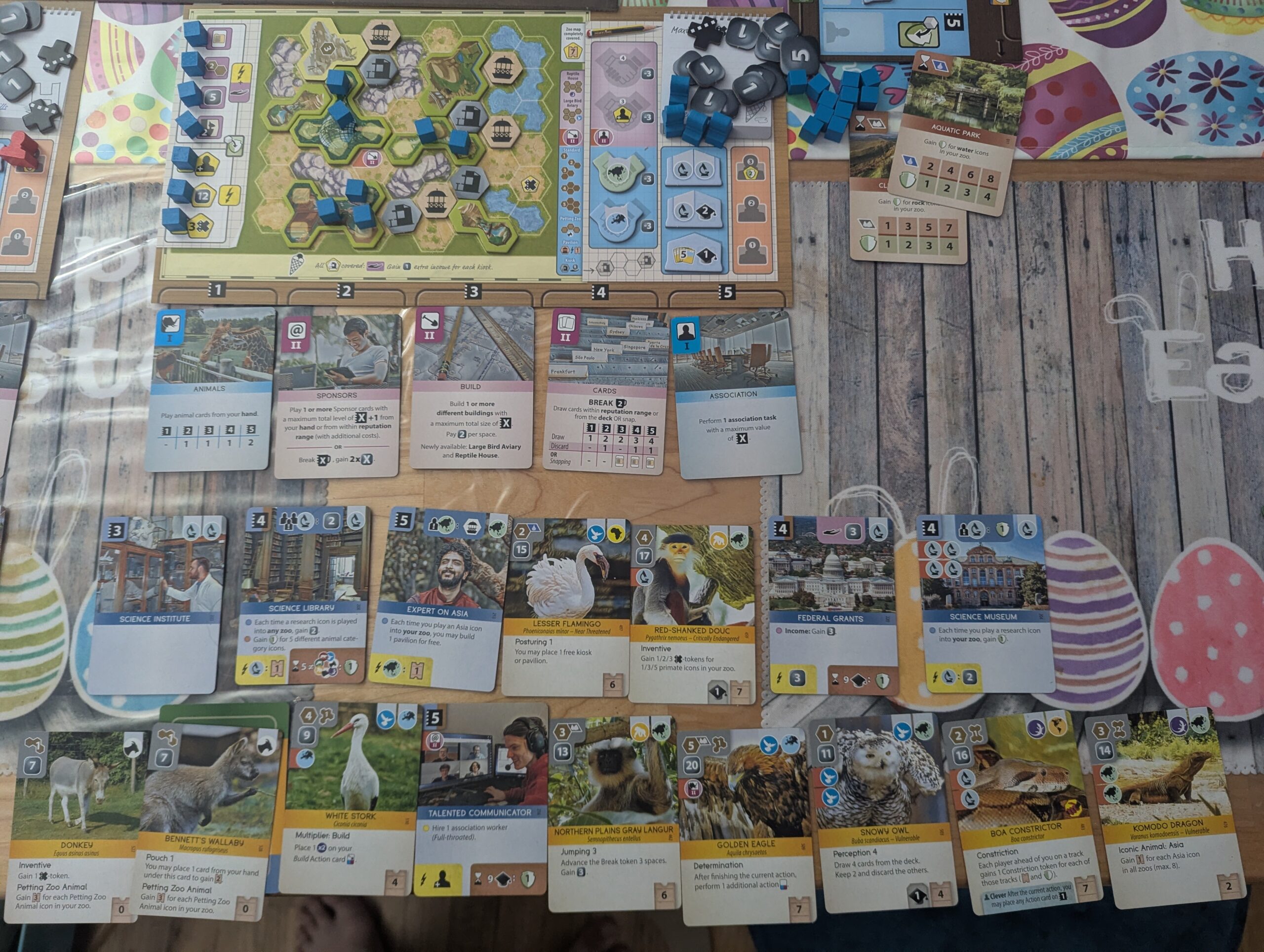
To gobble up points, players take turns taking one of five actions represented by five cards – Cards, Build, Animals, Sponsors, and Association. These cards sit in order from strength 1 to 5 and depending on where they are in this row when you play them they give you more options or better effects. After you take your action, you slide the card to the strength 1 position and slide all the other cards up to fill in its spot. This creates a dance where every turn you weigh the benefits and timing of what action you want to take at what strength. It also means there can be frustrating moments where the thing you need to do is not in the position you need it to be or you take a massively overpowered action to do something puny. As the game progresses, you gain the ability to level up these action cards and flip them over to their advanced side which makes them more powerful and flexible. In addition, the game spits out these X-shaped bonus tokens that can be used to boost actions so if you can turn a 3 strength Sponsors action to a 4 or higher depending on how many Xes you cash in.
The Cards action lets you draw cards from the deck or snatch up cards from the shared board. Most of the cards are animals but there are also sponsorship cards and conservation cards. At the start of the game you have a hand limit of three cards which triggers discarding at the end of a round but there are ways to boost up your hand size to 5.
The Build action is how you add buildings to your zoo and the stronger position the action is in, the larger or more buildings you can plop down. It costs 2 dollars per hex so a small enclosure or kiosk will cost you just 2 but an aviary or massive home for elephants will cost you 10. Buildings have to be built adjacent to previous buildings and certain features like rocks and water can prevent placement. Dotted on your map will be little bonuses that trigger when they’re covered up.2
The Animals action is how you start filling up your zoo with what everyone came to see. Before you can play them however you have to make sure there is a home for them. Most of the time they will go into empty enclosures. You mark which ones are filled by flipping them over. There are, however, some special buildings like petting zoos or reptile houses that can take multiple animals and is represented by placing cute little cubes into available slots. Whenever you play an animal, you trigger effects on the card. Most of the time you’ll add to your zoos appeal and your score will go up. Animals can also grant you bonus actions, let you draw more cards, or steal from your neighbors. The game helpfully comes with a thorough glossary of all the special abilities so you can clarify just what your marmosets and lemurs are getting up to. Along with their cost in dollars, some animals may have specific needs whether it’s being housed near water or in a zoo that has certain aspects already present. Animals have icons to determine both what kind of beastie they are (predator, bird, reptile, cute, etc) and which continent they come from. These icons will be referenced throughout the game so it’s helpful to store them where you can see them easily.
The Sponsors action allows you to either grab some extra cash mid-round or to play one or more of the many Sponsorship cards that grant you special bonuses or ongoing effects.3 Instead of costing money, these are limited by the strength of the action when you take it so if you’re at strength 4 you could play a Sponsorship card with a cost of 4 or less. These cards are very important to have readily at hand as they often grant you extra money or points based on what you and other players do.
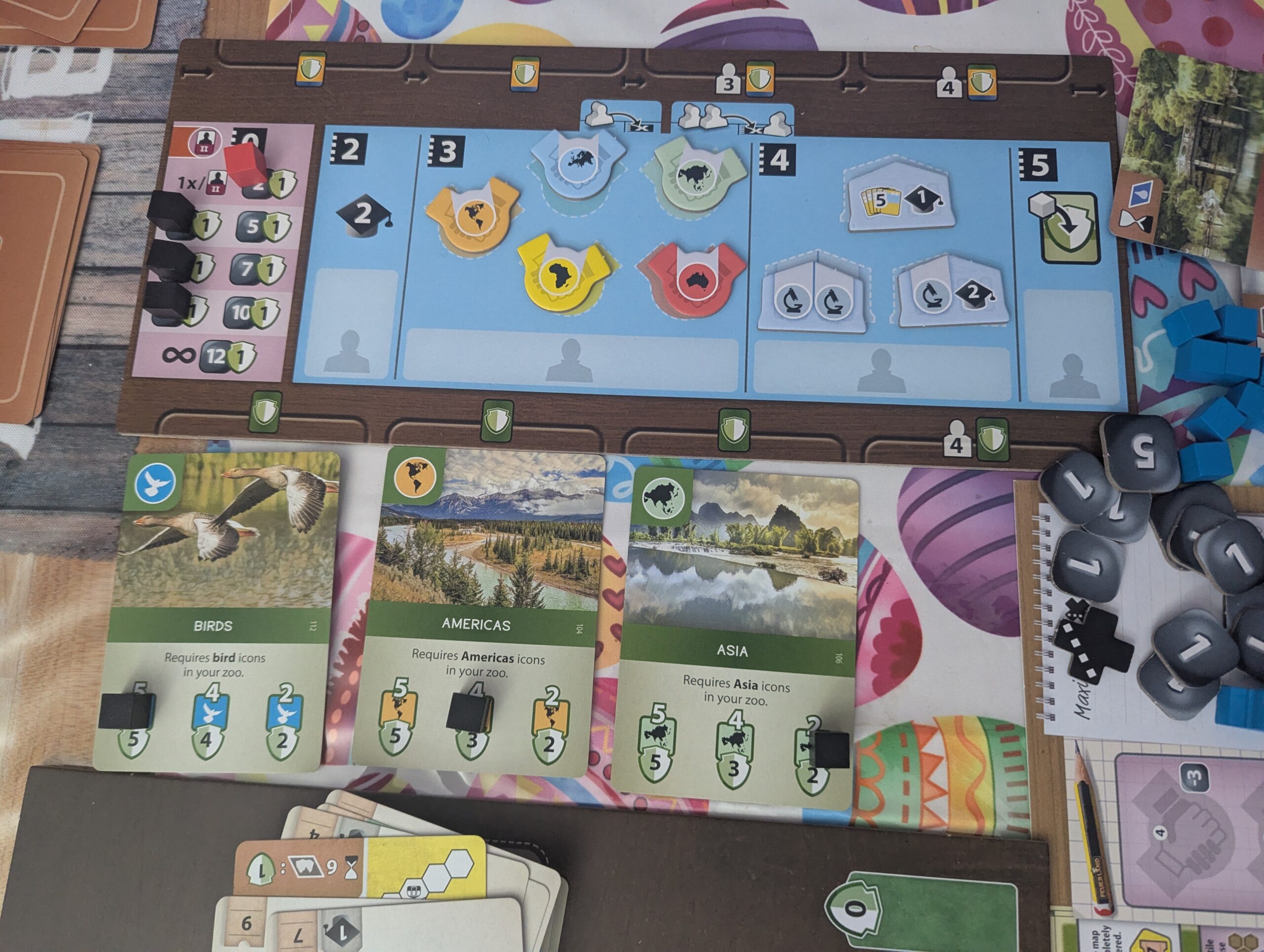
Finally there is the Association action which is the fiddliest and requires we go to our board annex. Thematically this represents sending administrative staff out to do PR and make connections with the broader conservation community. Like with Sponsors, the strength of the Association action determines which of the 4 actions you can take on the board with a 5th bonus action unlocked when you level up the Association action. Unlock any of the other actions, you also need to send out a little meeple to take this action. As the game goes on you unlock more meeples and can take more and more actions. The first is to boost your reputation (represented by the little mortarboard cap) which grants you special bonuses on a third (non-score) tracker. The second action is to partner with a continent which can make it easier to secure animals from that region. The third action is to partner with universities to grant reputation or research bonuses as well as increasing your hand size. The fourth action is to contribute to conservation cards4. You do this by taking a cube off your sheet (unlocking a little bonus, Scythe-style) and claiming one of the slots you qualify for, gaining a bump to your conservation score. In the picture above, players could try to collect birds, American animals, or Asian animals. At the start of the game, three of these base conservation cards are revealed and act as a shared motivation for all players but throughout the game new cards can be played and competed over. The bonus action allows you to donate cash for conservation points which can be a great late game catch-up mechanism.
The game consists of players picking one of these actions and going back and forth so it can be a very fast game, particularly early on when the engine isn’t quite pumping out bonuses and exceptions. The game doesn’t have predetermined rounds but there is a de facto one that is determined by the games Break mechanic. Certain actions, notably Cards and Sponsors can move a cute wooden coffee mug down the Break tracker until the Break is triggered. When this happens, players earn income, (both money as well as any other income bonuses accrued by Sponsors cards or other bonuses) meeples come home, hand limit is triggered, and a few other game effects reset. Once everyone has had their Break the game continues and rolls on until the next break.
I am many paragraphs in and still haven’t covered everything this game has to offer but I hope I’ve given a sufficient sense of just what all there is to do which is frankly, a lot. Faithful footnote readers will see that I keep being reminded of Terraforming Mars and there is a lot to compare in these games from length to complexity to similar engine building and glory chasing. There are significant differences particularly in the rhythm of the game and the way the action dance plays out. Of the two, I’m more likely to reach for the red planet but I won’t lie that there is something very satisfying about laying the groundwork and building the community ties so you can dumbo drop an elephant into a nice warm new home. This is a game of fun choices and I can understand why it’s been a BoardGameGeek darling for years.
This will not be the first shared similarity with everyone’s favorite game of making Mars wetter, hotter, and greener. ↩︎
Some games I discover organically through word of mouth, playing over at a friend’s, or stumbling across at a friendly local game store and deciding to give it a shot. Other games I discover through the less than savory process of being advertised to by an algorithm that, while blind, stupid, and dumb, is just canny enough to know what causes my heartrate to elevate and my eyes to dilate just enough to prompt questionable financial decisions. Valeria was one such game and maybe even one of the earliest games that slid into my peripheral vision and gave me pause. Without anything but vibes to recommend it I ordered a copy and it has been a fantastic go to game over the last decade which is good news for advertisers and bad news for my wallet as behavior that’s rewarded is repeated.
The game for all its fantastical beasts and locales is in essence and economic engine builder. Everything you want to do takes either money or power in the form of tokens and you acquire them every turn (yours and your opponents) by rolling dice and checking your ever growing tableau. At the start of the game, all you have to recommend your prowess is one peasant and one knight who will toss you one measly coin if you or an opponent rolls a 5 and one smidgen of power if you roll a 6. From those humble beginnings however you can forge quite a machine. In the center of the table are ten other heroes who represent other rolls of the dice and each offers up their own unique payout. These payouts occur both on your turn and on your opponents’ turns so paying attention to what’s going on is paramount.
In addition to heroes there are also Domains which represent locales and buildings you can add to your tableau. These pricey cards mostly offer up big points at the end of the game but they also will have either immediate bonuses or ongoing effects. To purchase them you both have to have enough money and you need to have heroes whose symbols match the ones on the domains.
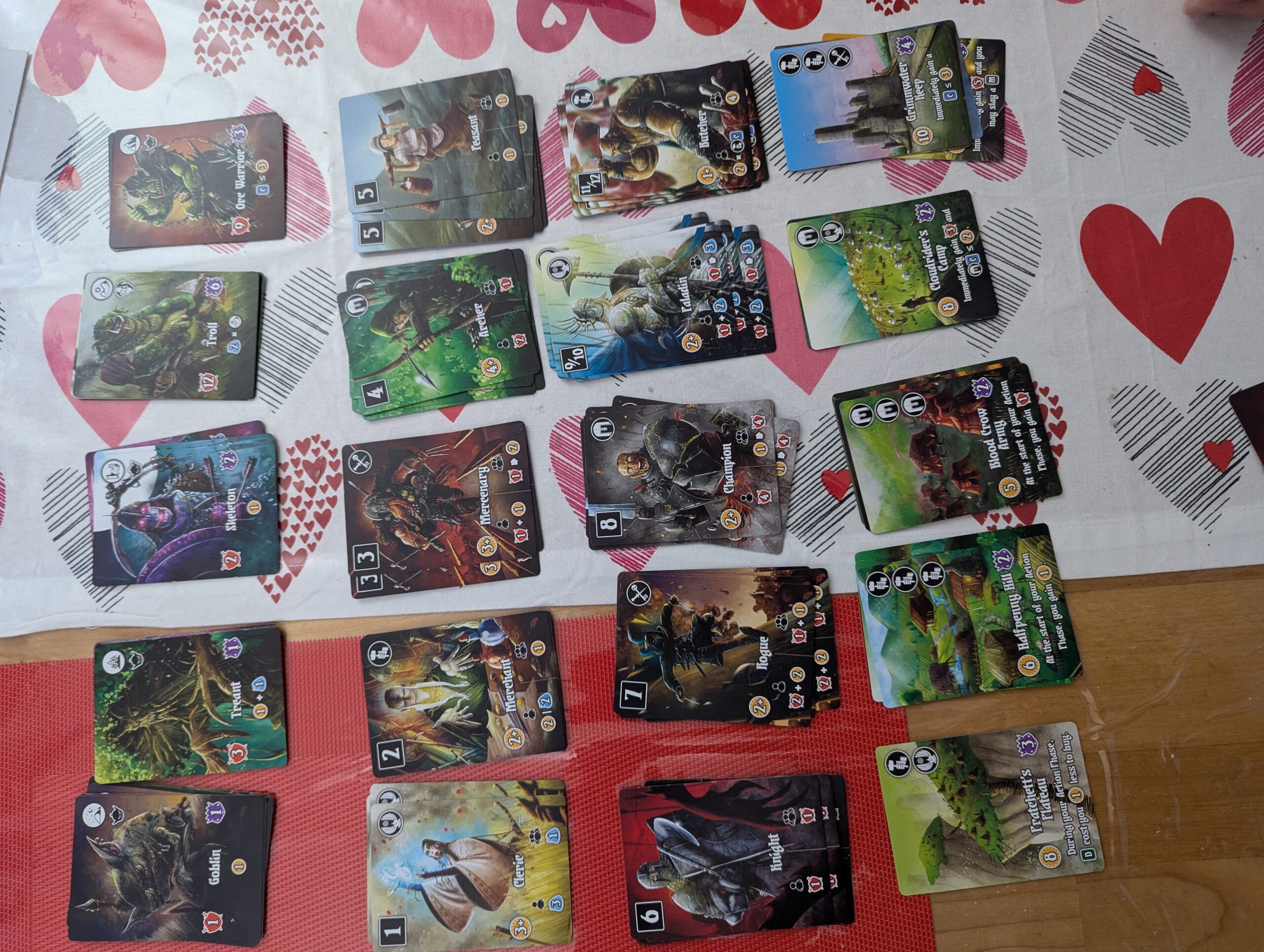
Finally there are the big nasties that hover above the game like threatening treacle. Each of them requires power to eliminate and provides points and prizes for doing so. They represent different terrains (swamps, mountains, forests, etc) and as you go through each pile the monsters get harder and eventually culminate in a challenging boss fight that grants big rewards particularly if you were the player to eliminate its minions.
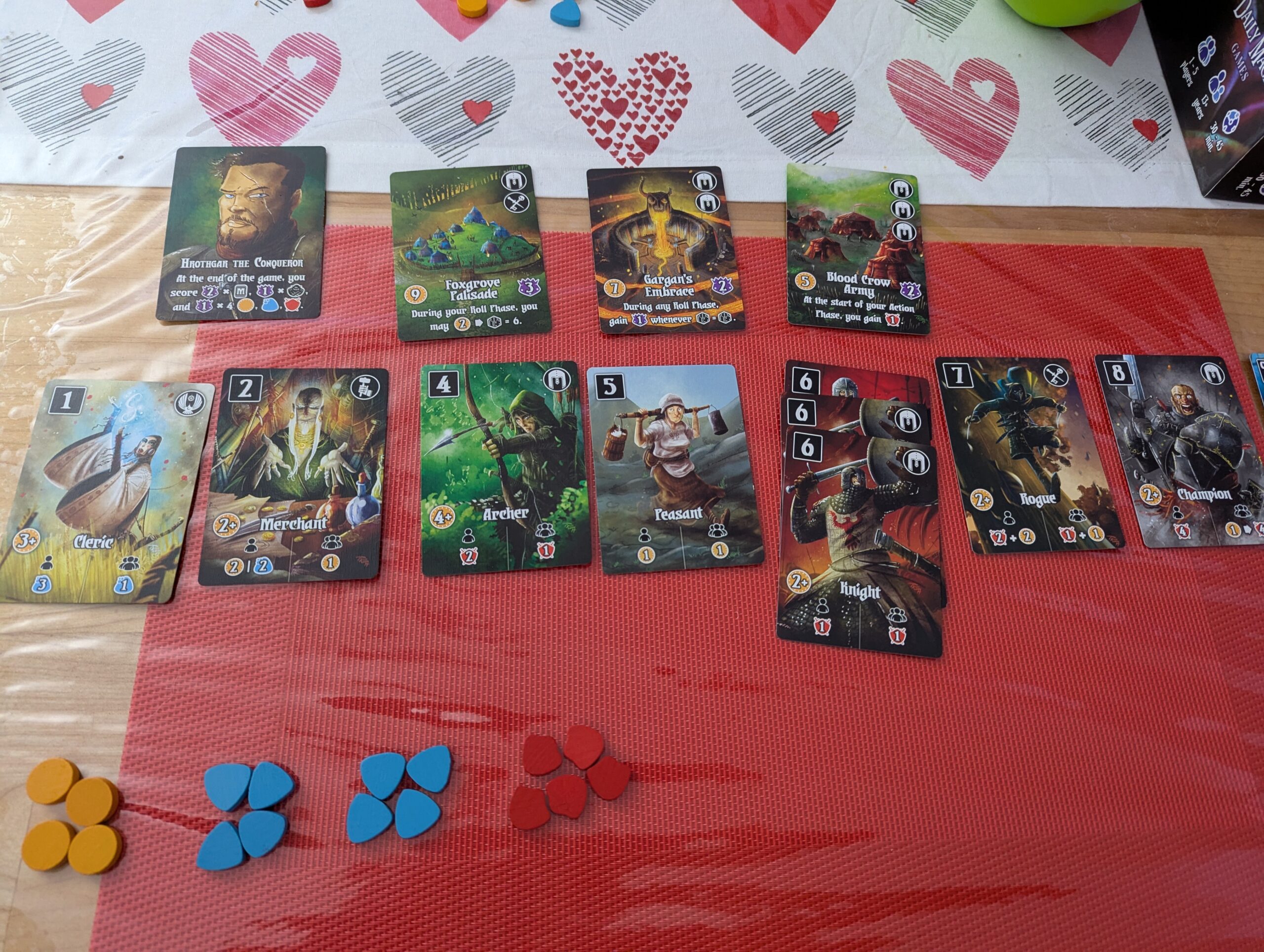
Savvy readers will note that I’ve talked about money and power tokens but there appears to be a mysterious third thing in the above picture and that is magic. Magic is a wild resource that you can spend to supplement the other two although you have to pay at least one token of that resource. This grants a degree of flexibility in planning. Also, some monsters require raw magic in addition to power to defeat so having a little magic in your pocket is never a bad policy.
At the end of the game, players will reveal the secret Duke card they drew way back at the start and that will reveal what bonus points they get for defeating monsters, building domains, hiring different types of heroes, stockpiling resources and so on. These Dukes give you a shape and a strategy you can pursue but aren’t too restrictive in how you go about playing. Most of your points will come from defeated monsters and towering Domains.
Card Kingdom Valeria is a fun workhorse of a game that manages to capture the whimsy of a fantasy monster battler with the puzzle of an economic engine builder. The game comes with different heroes for each die count as well as different groups of monsters so you can mix and match and develop wildly different games depending on which ones are available, The art is fantastic and the way you hold your breath on everybody’s turn praying that the dice go your way keeps things engaged and the game running very quickly. An easy recommendation from me, an actual human.
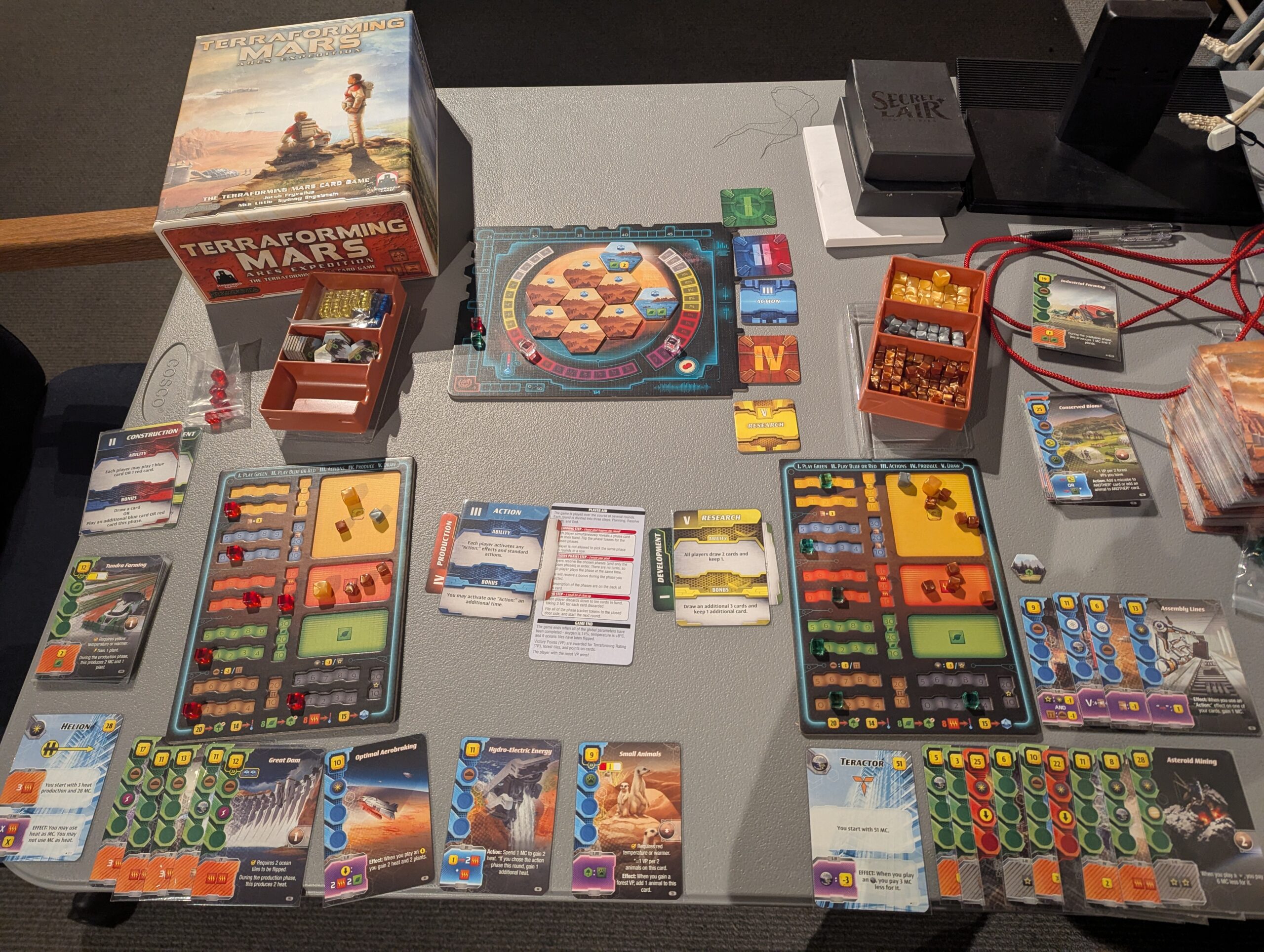
Longtime followers of this blog and my online ramblings will know that I am a hardcore (if occasionally conflicted) fan of the Terraforming Mars board game and its many many expansions. When I learned that they had put out a streamlined version, I was interested but also felt like I couldn’t justify paying for a brand new version of the game that couldn’t make use of the Too Many Expansions I had invested in. (quick sidenote, if you’re only going to get one thing to improve the game, get these custom player boards) Luckily, my friendly local game store had a copy for patrons to peruse so I popped it out and did just that so I could bring my findings to you all.
The goal of both Terraforming Mars games is to make the red planet wetter, hotter, and greener through spending money on terraforming projects and also playing various cards that either offer one time rewards or long-term effects. Players play as different corporations with unique bonuses. After that, the games’ similarities diverge. Original Terraforming Mars is a big chunky engine builder where players take long turns going back and forth prioritizing which cards to play or which actions to take. There’s a lot of choice although you are often constrained by what cards come your way.
Ares Expedition is a much more streamlined game that borrows a concept from Race For the Galaxy that allows for very quick turns. At the start of a round, players take turns secretly picking one or two of five different actions. They reveal their actions and then those are the only actions available to all the players for the whole round with the player picking it getting a little bonus. These actions include drawing new cards, gaining resources, taking actions, and playing specific kinds of cards. Players take these actions at the same time so rounds go by sharp and quick.
Instead of the big map of Mars dominating the table with all its strategic choices about where to plop down cities or crack open aquifers, Ares Expedition gives a much smaller and more abstract board simply to indicate how wet, hot, and green things are getting. This makes for much less table presence and allows players to focus more on their hands and the cards in front of them. The art on the cards is also less chaotic and more standardized across the whole game.
Of the two games, I still prefer the original but if I was at a game night with acquaintances or strangers I’d feel more comfortable suggesting Ares Expedition as a quicker, faster, more compact game that we could finish in a quarter of the time. I’m glad I got my chance to poke and prod but I feel justified staying with my unnecessarily large boxes.
Coming soon will be my thoughts on their upcoming RPG…
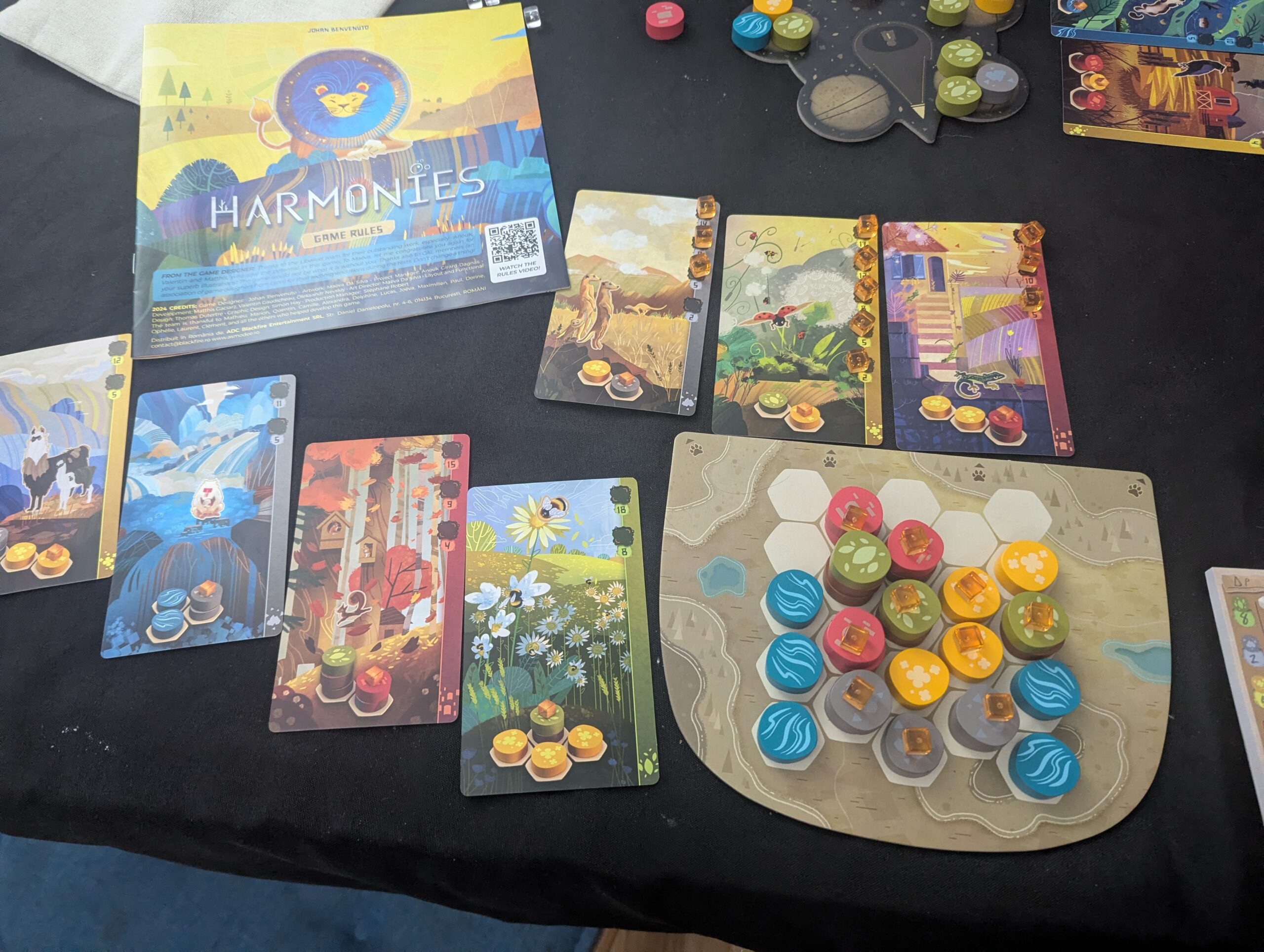
Every Christmas my in-laws request a list of presents I might like which at first was a very alien experience for me as my family’s gift giving technique involved guess work and surprise which is how I wound up with SAT prep software one Christmas and my brother got a pair of curved glass-handled daggers for another. That being said, occasionally my list isn’t robust enough to match my in-laws’ generosity and they have to parse their knowledge of me to come up with something surprising and delightful. This is how the above copy of Harmonies entered my gaming library this year.
Last year I wrote up about the gentle animal and tile placing game Cascadia and on the surface Harmonies seems to be made of similar stock. Every turn you are presented with terrain tiles you need to situate on your player map and then you can try to populate them with different wildlife like bees and ocelots. While Cascadia is a game of fairly relaxing building out and up, Harmonies presents a more intense experience.
For one thing, the space you’re working with feels much more limited. Your map has two sides that offer slightly different game modes but both are going to constrain what directions you can build out in. Where you can try to maximize space is by building up as well as out. While rivers and fields are limited to one tile in height, trees, mountains, and buildings let you stack two or three high so your spatial reasoning is going to be given a workout.
Secondly you can’t just pop any old animal in any old spot. Animals in this game are very specific about where they want to live. Bees want to live in a tree surrounded by no less than three fields. Llamas want to live in a field next to a field which is itself next to a mountain. Every turn you can go shopping in the animal market and it feels almost like a stock market game. Just how valuable are the beavers going to be to me in the future? Am I really going to have enough trees to make this worth my while or should I double down on squirrels? Animal populations are tracked by cubes that start out on the animal card and as you open up habitats for them, they move onto your player map. The more you plonk down, the more points you get at the end of the game. However, once you’ve populated a mountain or a tree, that’s as high as it can get and no other animal can call it home so plop wisely.
At the end of the game points are awarded both for the number of animals you’ve found homes for and also for how you’ve laid out the terrain. This is a tricky bit of business that can make the rest of the game feel a lot tighter. Rivers just want to be long and windy and trees want to grow high which is simple enough. Mountains also want to be tall but they only score if they’re next to other mountains. Buildings want a variety of terrain touching them or they’ll withhold all their points. Fields want to be set down in groups of three and that’s it. On the alternate player map side, instead of rivers you’re building islands which have their own scoring needs. Keeping all these different rubrics in your head while also trying to shove bears and lizards onto logs and rocks gives this game a lot more edge than its happy pictures and colorful tiles might suggest.
If however, all that seems too simple for you, they have an advanced mode where you also have these super animals you’ve got to find spaces for so go nuts!
This game is fast and intense so suited well for an early night game to get the blood pumping rather than an end of the night cooldown game. Fun and full of replayability. Get stuffing those squirrels!
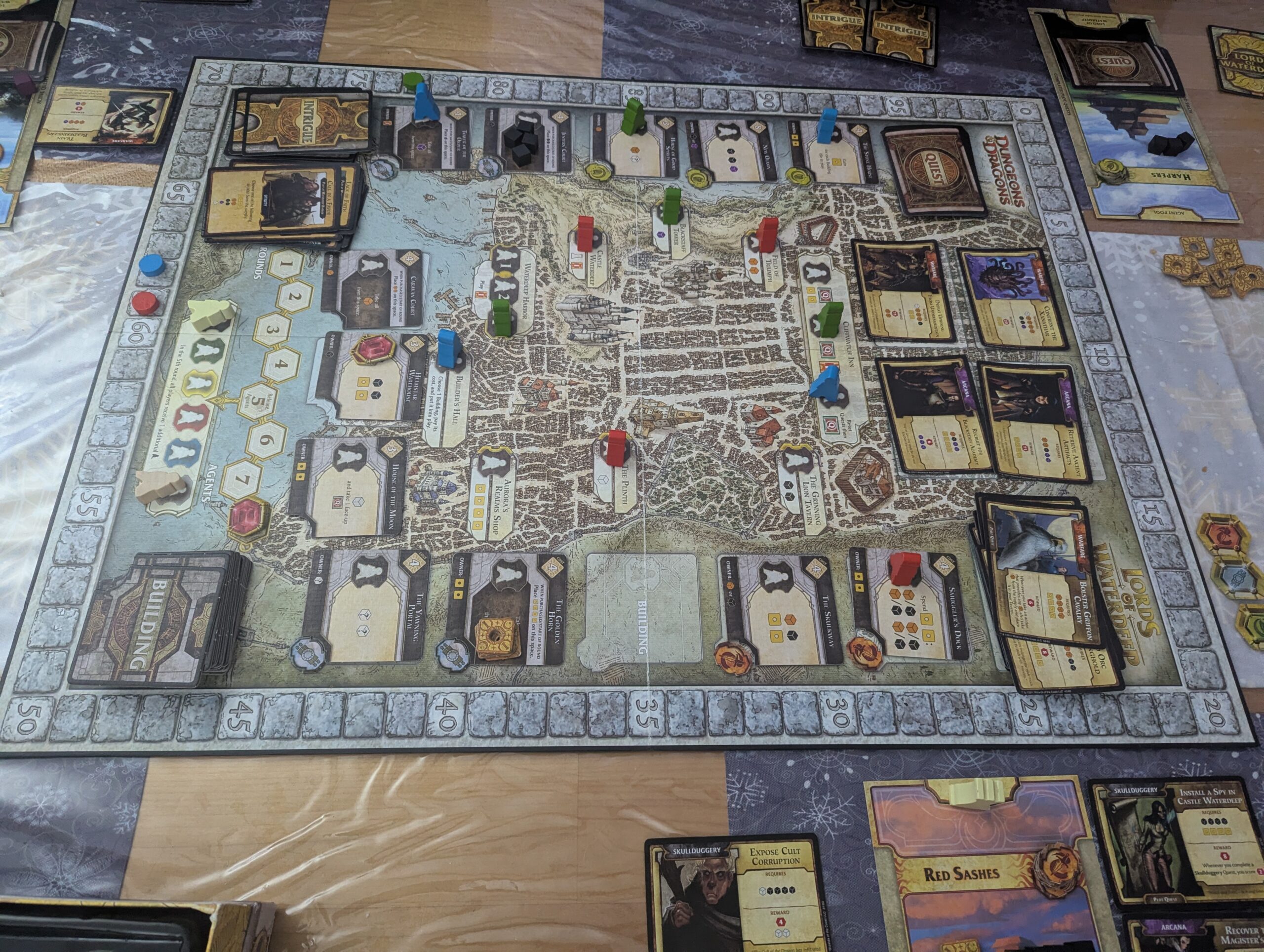
A little while back, my son and I both contracted COVID and were sequestered up in my bedroom with a pile of board games and Waterdeep was probably our most played game during that time. This has led to some unfortunate mental associations every time I consider bringing it out but not enough to fully dissuade me which was how it came to be our main menu item at my regular Wednesday game night.
My lovely British boys over at Shut Up and Sit Down uncharitably called it “aggressively mediocre” and they are entitled to their opinion but I have found over the decade I’ve been playing it that it sits at a sweet intersection of complexity and ease of play.
The premise of the game is that the players are the titular and secret lords of the Forgotten Realms metropolis Waterdeep vying for supremacy in the form of victory points by recruiting heroes, collecting gold, underhandedly intriguing, and fulfilling various quests. Every round players take turns putting their agents in a fairly straightforward worker placement game. Every game is exactly 8 rounds so players have to time things just right to maximize their point potential before facing the Great Accounting.
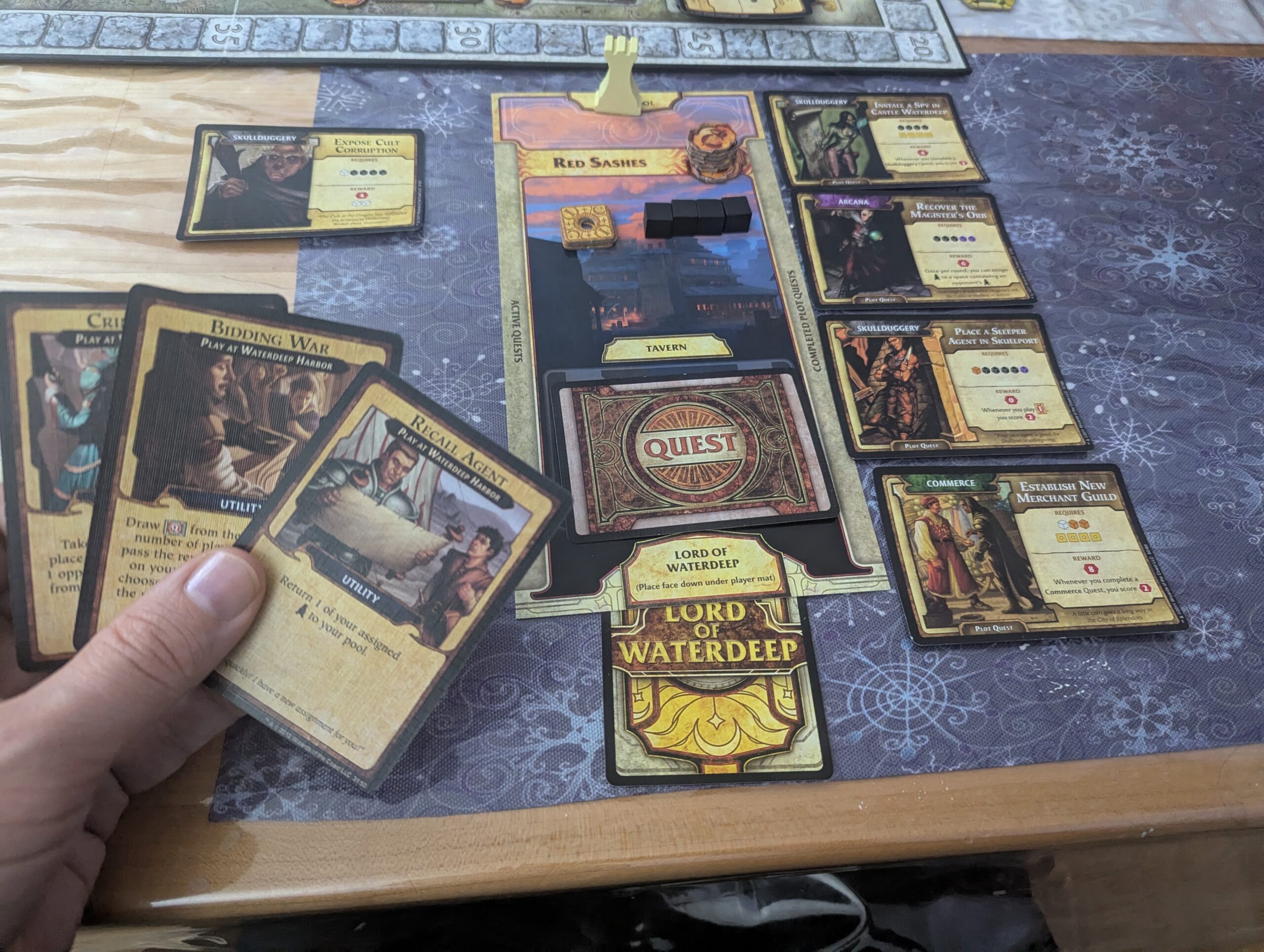
The core of the game of getting Quests from Castle Waterdeep which fall under various categories – Arcana, Commerce, Piety, Skullduggery, and Warfare. To fulfill these quests, players need to collect and subsequently spend gold and heroes. (this incidentally is my favorite mental image of the game as players acquire and discard adventurers like so much lumber and sheep.) Most quests give rewards in the form of points and resources although some quests are Plot Quests that offer up bonuses for the rest of the game. Choosing the right quests and paying attention to other players’ quests makes up a large strategic element of the game.
Different locations on the board give you the resources you need and exclusively block out other players so in games where clerics are in high demand and short supply, going first can be a cut throat business. One location allows players to spend gold to build a new location which can help mitigate some of these shortages while also giving a nice bonus to the builders. Halfway through the game, players get an additional agent to help them take even more actions. By the end of the game you have a very different and active board then the one you started with but the choices and base mechanic are still largely the same throughout.
The most finnicky location are the Skullport Docks which allow players to play Intrigue cards from their hands which can do everything from give them additional resources or force their rivals to waste their time on mandatory quests. After all the agents have been assigned, any agents at the docks get to take a second turn which can lead to some interesting late round choices.
For a game with as many moving parts as Lords of Waterdeep, set up and gameplay go fast. There are always just enough interesting choices without too much analysis paralysis. The art is nice and thematic and scoring doesn’t take an age and a day. I highly recommend it for folks wanting to encourage their roleplaying group to try their hand at economic style board games. It’s a nicely steep slope from taming owlbears to growing algae on Mars. Get to it!
After my kidney stone battle last New Year’s gave me a new lease on life I decided the one thing I wanted to do with my brief time on Earth was play and write about board games and I managed to accomplish both.
I had regular standing game night with two of my dad friends as well as a neighbor who frequently stopped by to try out games so there were a lot of opportunities to fling dice, draw cards, and enjoy time with friends.
Of all the games this year, I think Vantage proved the surprise star hit. It’s a bonkers game and I have squeezed about as much juice out of it as I feel like I need but man alive it hit me at just the right time to really give me a great time.
One notable highlight this year was getting to bring friends together twice to play Twilight Imperium, a game where the real victory is finding the time and opportunity to play a whole game.
In 2026 I hope to build off the trend but what I really want is to add more friends to my gaming roster. With the new friendly local game store, I might very well get that opportunity. For now, I’m very grateful to all of you who went on this journey with me. Let me know what games you’re playing or hope to play in the coming year.
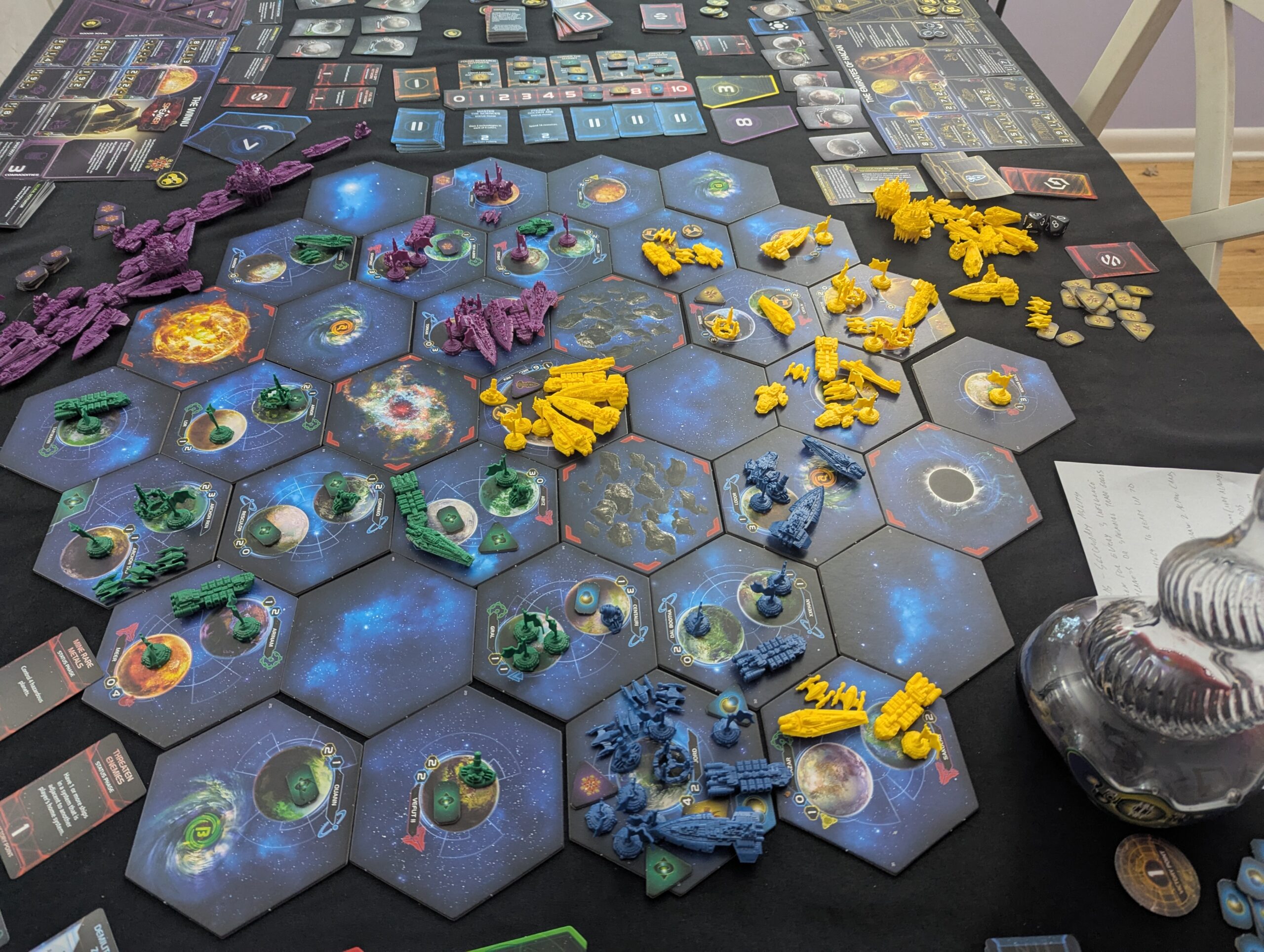
In space, no one can hear you schedule. As with many games of the size and time commitment of Twilight Imperium, the real challenge is organizing and coordinating calendars as I detailed here. Once you overcome that hurdle however what awaits you is a truly unique experience I will endeavor to describe here.
(I am only speaking about the base game of the 4th edition here. If time and finances allow, I’ll come back to discuss the expansions)
Twilight Imperium is a big game and as such it can be an intimidating one but as my friends discovered over the 6 hours we played, given the right atmosphere you gradually acclimatize to it and what seemed insurmountable in the first hour before proves to be a fun romp. Part of this transformation has to do with how the rules interconnect. It’s an ecosystem where you can trace the fungal networks and food webs to grasp what the game allows.
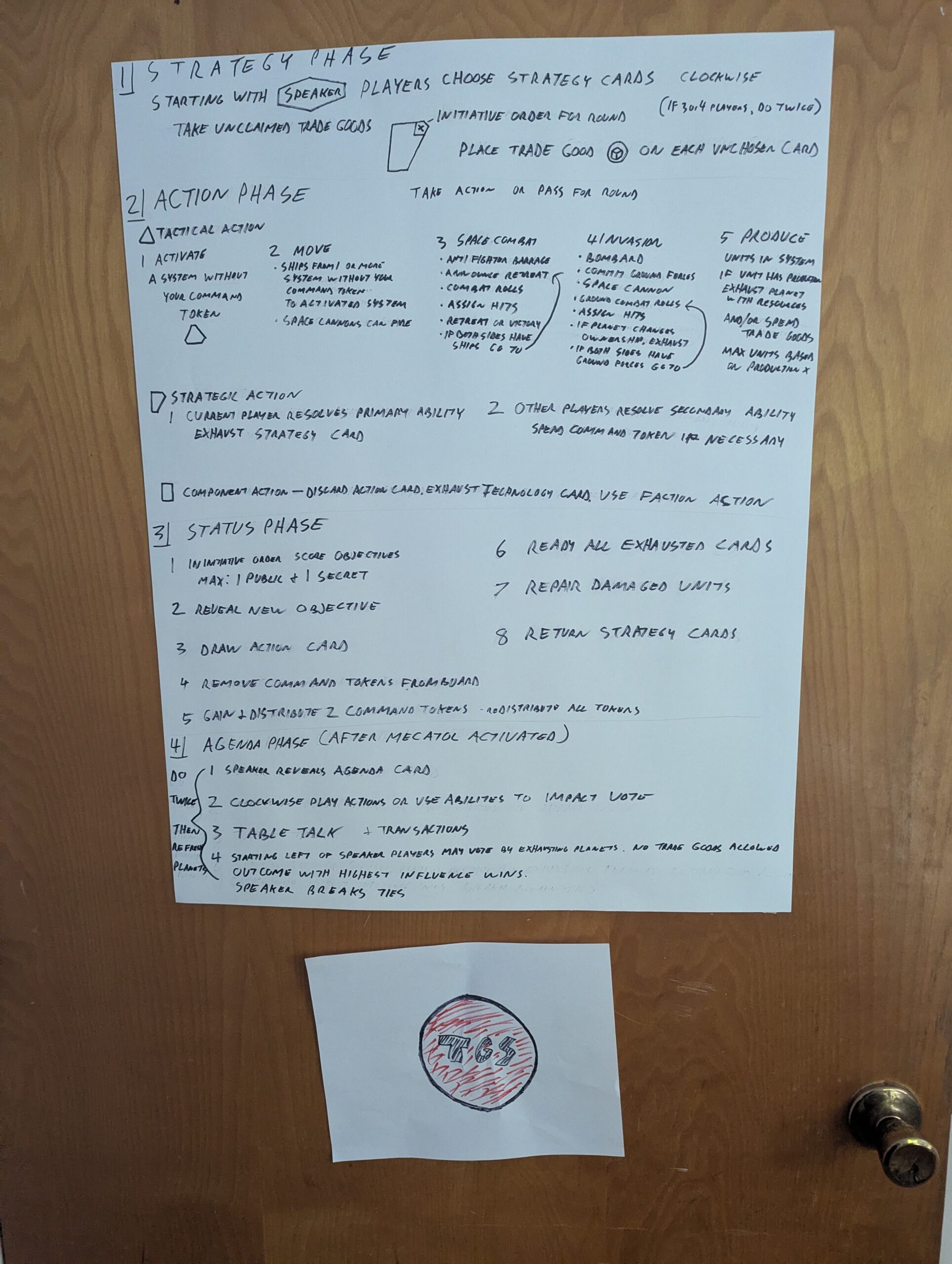
These were the two handouts I provided for my players. The first outlines the shape of the round so we could easily figure out what we needed to do in what order without flipping through rulebooks. The second is the This Game Sucks button so at any time players can nope out judgement free. When Rachel saw it she got a horrified look and said “your game needs a safe word?!” which first of all, rude, and secondly, fair. This tradition comes from my brothers who often would caveat any big complicated game by saying that anyone could invoke TGS to end things rather than feel obligated to slog through. This permission often gives folks more of a willingness to get past the initial barriers some games throw up and I’m happy to see this game wasn’t an exception.
Twilight Imperium is a space opera simulator with victory assured by warfare, colonizing, trading, researching, and diplomacy. The many many rules all provide the guide rails for pursuing those various paths to victory but the size of the game is such that many branching opportunities show up over the rounds and while one player might get an early lead there are no sure things and (usually temporary) alliances often form and dissolve to try to take down upstarts. It’s almost as much a social game as it a strategy game. Trying to barrel through the galaxy depending on your own strength more often earns you a total wipeout. Victors are often those who slowly accumulate power while not drawing attention to themselves.
Victory comes from Victory Points which are scored through randomly selected Public Objectives that everyone can work towards and Secret Objectives that are known to and score-able by individual players. At the start of the game there are only a few Objectives to pursue but by the end there can be as many as 13 to provide you with a veritable buffet of victory conditions. Finally there is a central planet called Mecatol Rex on the map and gaining and maintaining control of it can earn points in a King of the Hill style scrimmage.
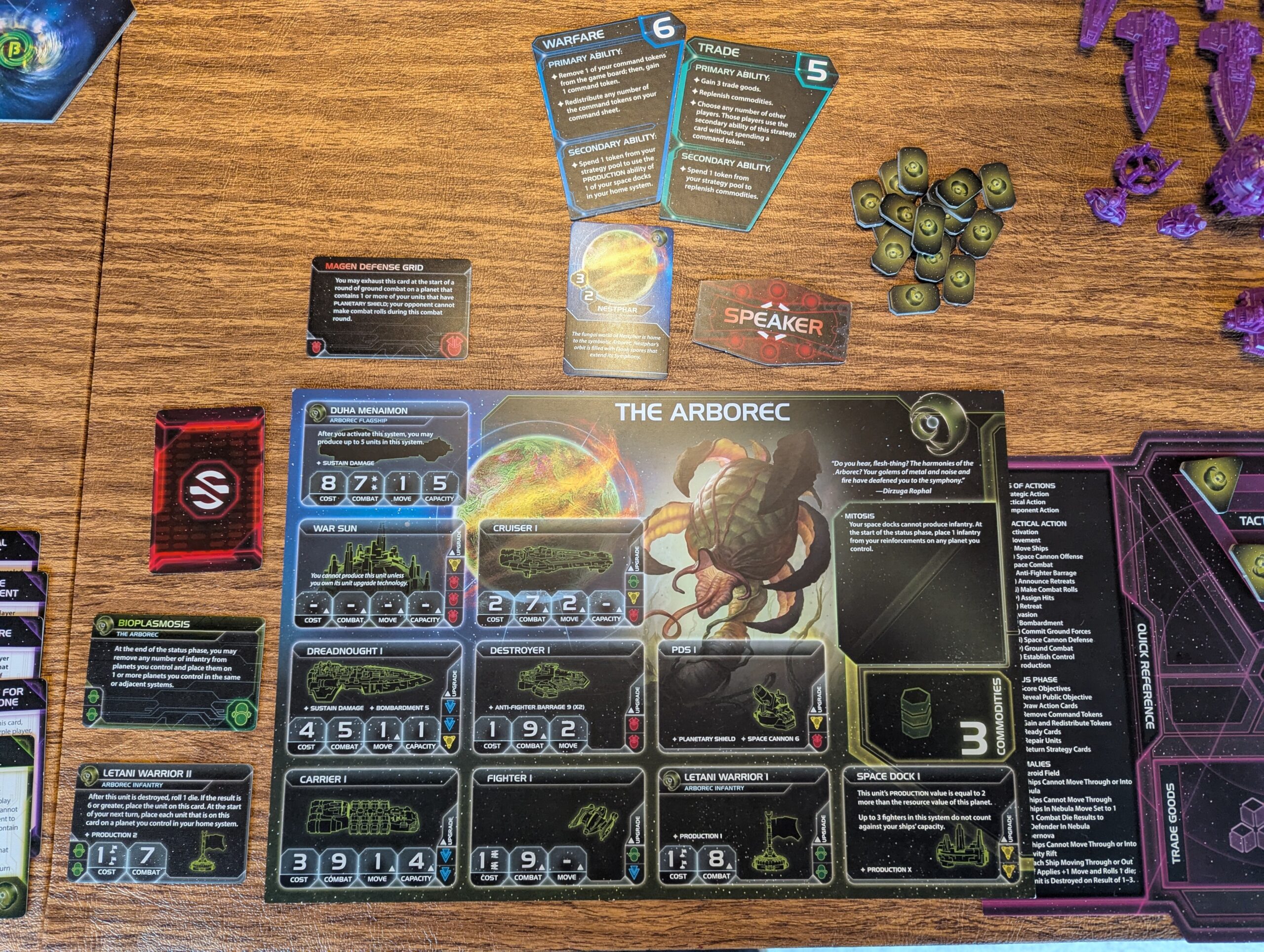
The first step of the game is picking one of 17 factions that will determine the shape and flavor of your game. Many of the races highlight (or exploit) one of the core mechanics and are often suggested for beginners. There are lions who excel at trade, turtles who do diplomacy better than anyone else, a university that masters research, and humans who… breed. After these base factions things start to get a little wild. As the 4th iteration of a game with many offshoots, expansions, and novels, there is a deep well of lore and species that the designers felt beholden to include. This means that you wind up with jaunty pirates, furry nomads, creepy cultists, sentient viruses, and a giant plant who just wants to spread its love and spores throughout the galaxy.
Factions come with their own special abilities and/or limitations as well starting planets, space and ground forces, and technology. They also have Command Tokens which are the most crucial element of the game. Command Tokens get distributed on your player board between your Tactics, Fleet, and Strategy pools. Command Tokens from Tactics are spent to move ships, invade planets, and build more forces. The number of tokens in your Fleet determines how big your individual armadas can be. Finally, tokens from your Strategy pool get spent to unlock abilities from the Strategy Cards.
At the start of every round players will choose 1 or 2 Strategy Cards which determines round order as well as granting access to special abilities like gaining more Command Tokens, researching new Technology, gaining Trade Goods, and more. Whoever picked the card at the start of the round can use the powerful primary ability but other players have an option to spend a Command Token from their Strategy Pool to use a Secondary Ability which often is a smaller version of the Primary one. This mechanic keeps everyone engaged even when it’s not their turn and provides opportunities. Most of these secondary abilities are smaller versions of the primary one but others are not. Take the Warfare Strategy Card. It allows the player who drew it to pick up a Command Token from the board and use it again which provides some strategic flexibility or speed but it lets everyone else produce units in their home systems as a sort of arms race trigger. Thematically it all ties together very nicely. The Strategy Cards are also all numbered and determine the turn order which is often vital to how a round shapes up. Mastering order of operations is key to conquering the galaxy.
After Strategy Cards are acquired and turn order established, players go around in that order either playing those Strategy Cards, using actions from their Action Cards, faction abilities, and tech, or using the Command Tokens to move ships, invade planets, and build units. Command Tokens sit on the board and they limit how often you can activate a planet or the forces present there. Say you want to invade a neighboring system, you would place a Command Token on it and then move any ships in range into that system. If there are any enemy ships, this triggers a space combat and then if you have ground forces and there’s a planet to drop them off on you can do that but once again, if there are any enemies present, you are required to have a ground combat. There is no sharing or peaceful coexistence in Twilight Imperium. Go play Cosmic Encounters for that sort of hippy business. On subsequent turns, that Command Token now present in the system means you cannot activate it again or move any ships there out of that system. It locks everything in place. This is why Warfare is so powerful as it lets you move ships twice which can cause all sorts of anxiety for the rest of the galaxy.
To pay for all the cool things you want to do you need a way to pay for them and there are two main sources – Planets and Trade Goods. Every Planet has two scores, one that represents material Resources and another that represents cultural Influence. Resources are spent to build ships and troops as well as Research. Influence can earn you additional Command Tokens when someone plays the Leadership Strategy Card and is also necessary to bully the guardians of Mecatol Rex into crowning you uhhh liberator. Influence also gets used for voting during the Agenda Phase. To represent using a planet’s Resources or Influence you flip it over. Recently conquered planets start off flipped over so cannot be used until refreshed. Trade Goods are most often acquired through the Trade action although you are able to trade with any neighboring players on either of your turns. They count as wild resources and can be used for either Resources or Influence.
Researching new and exciting technologies is an important part of the game and falling behind as your neighbors get bigger and shinier toys can lead to some lopsided gameplay. When you research, you gain new technology cards which either improve your units or give you additional actions or powers such as faster ships, stronger weapons, more efficient workers, etc. Basic technology can just be researched freely but more advanced ones will come with prerequisites, usually in the form of earlier technologies. Some planets will have a technology symbol on them and can be flipped over to fulfill those prerequisites.
Control of the central planet Mecatol Rex can provide victory points provided you snag the Imperial Strategy Card and indeed a player choosing that at the start of the round is a giant red flag to the rest of the players to unite against their overweening ambitions. To gain control of the galactic capitol you need to have ground forces physically on the planet and to have spent the necessary Influence. This only needs to be spent once and provides a permanent victory point to whoever uncorks the planet. When it subsequently gets conquered and reconquered, no Influence is needed. On the round that it is claimed, the Agenda Phase is added to the game round. This is where players can vote on different laws and resolutions and elections to make their galaxy a more lively place.
While Diplomacy is a physical Strategy Card you can play, its lower case cousin is a vital concept with deep importance for the entire game. Who you attack or trade with is a vital decision that not only impacts you but the whole table. Often times the folks trying to push a combat are not the primary belligerents but their neighbors who hope to profit off the carnage. Every faction is given Promissory Notes that they can offer to try to sweeten deals or discourage aggression. Many of them act as nothing less than hostages being exchanged for good behavior. A twisted quirk of the game is that you can take a Note given by one player and trade it to another which means that if you promise not to attack the lions to focus on the vampires you can very quickly run into those same vampires screwing you over with that same treaty.
After all Strategy Cards have been played and players have no more actions they wish to take, the board refreshes with exhausted planets flipped back over, Command Tokens taken off, new Action cards drawn, and Objectives scored. If the Agenda Phase has been unlocked, players go around voting and horse trading. After all that, if no-one has outright won, a new round begins with more Public Objectives unlocked and the carousel continues.
I will not argue with you that Twilight Imperium is excessively big and unwieldy and remember that this has only been focused on the base game. The expansions add leaders, mechs, exploration opportunities, artifacts, and more more more. It is wildly unbalanced with some factions being much harder to navigate and bring to victory than others. Turns are long and there are so many details to track and frankly you will forget thar you researched an ability that you could have just used or lost track of just who holds your trade agreement Promissory Note. That being said, it is a truly unique and delightful experience given the right company which so far I’ve been lucky to enjoy. It’s an aspirational game that requires logistical foresight and spousal negotiations to bring to the table but when pulled off, is deeply rewarding.