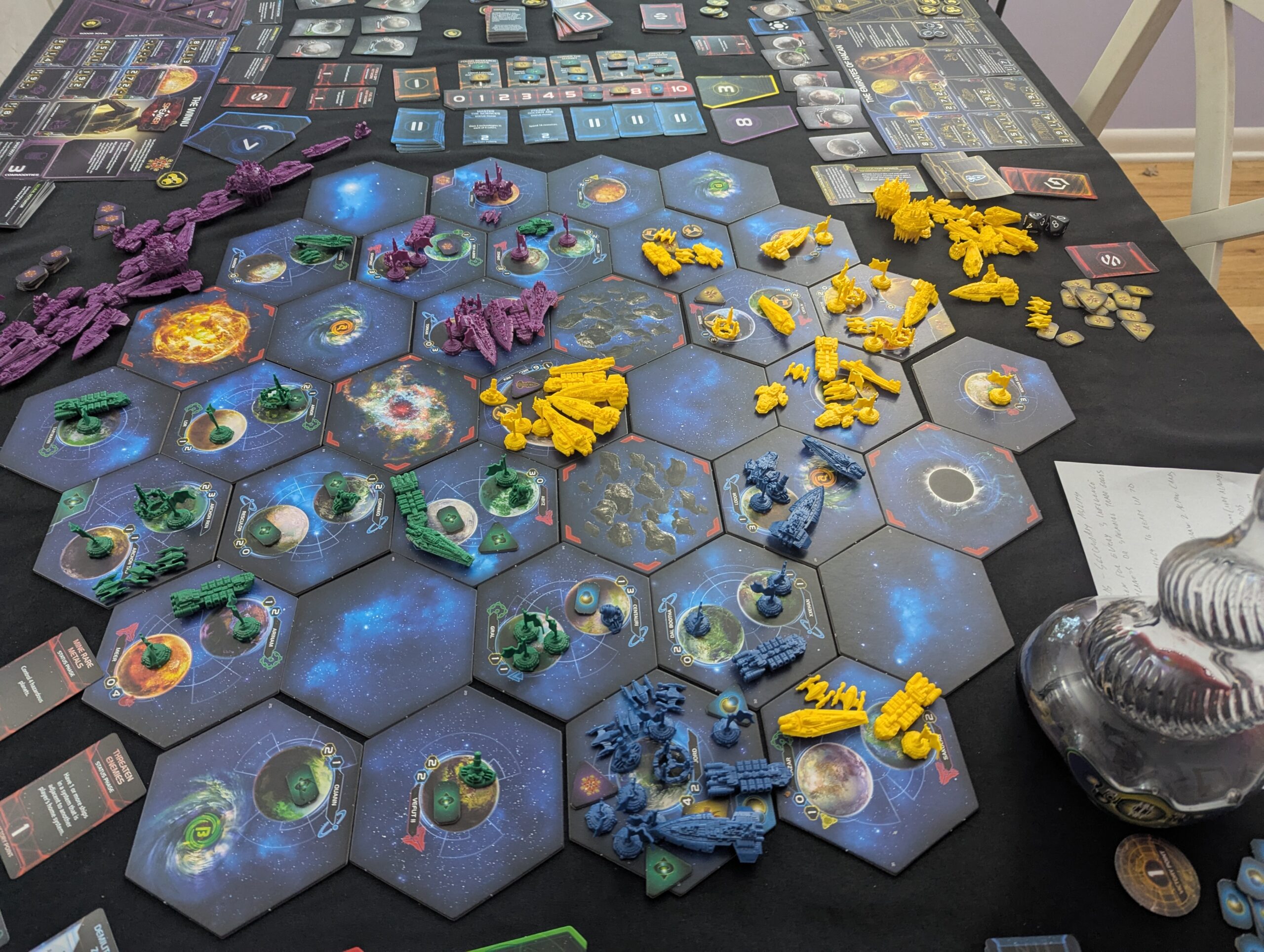
In space, no one can hear you schedule. As with many games of the size and time commitment of Twilight Imperium, the real challenge is organizing and coordinating calendars as I detailed here. Once you overcome that hurdle however what awaits you is a truly unique experience I will endeavor to describe here.
(I am only speaking about the base game of the 4th edition here. If time and finances allow, I’ll come back to discuss the expansions)
Twilight Imperium is a big game and as such it can be an intimidating one but as my friends discovered over the 6 hours we played, given the right atmosphere you gradually acclimatize to it and what seemed insurmountable in the first hour before proves to be a fun romp. Part of this transformation has to do with how the rules interconnect. It’s an ecosystem where you can trace the fungal networks and food webs to grasp what the game allows.
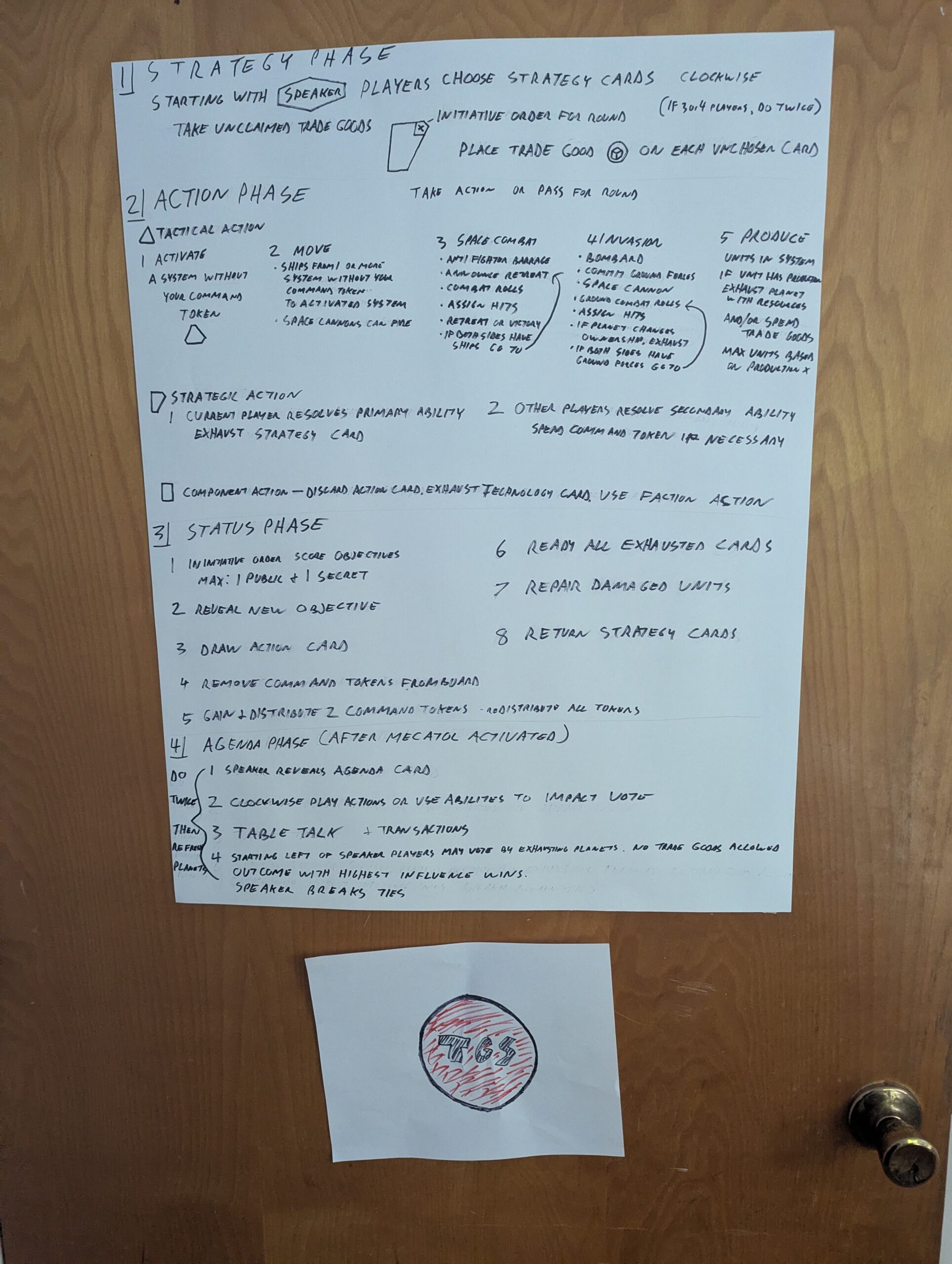
These were the two handouts I provided for my players. The first outlines the shape of the round so we could easily figure out what we needed to do in what order without flipping through rulebooks. The second is the This Game Sucks button so at any time players can nope out judgement free. When Rachel saw it she got a horrified look and said “your game needs a safe word?!” which first of all, rude, and secondly, fair. This tradition comes from my brothers who often would caveat any big complicated game by saying that anyone could invoke TGS to end things rather than feel obligated to slog through. This permission often gives folks more of a willingness to get past the initial barriers some games throw up and I’m happy to see this game wasn’t an exception.
Twilight Imperium is a space opera simulator with victory assured by warfare, colonizing, trading, researching, and diplomacy. The many many rules all provide the guide rails for pursuing those various paths to victory but the size of the game is such that many branching opportunities show up over the rounds and while one player might get an early lead there are no sure things and (usually temporary) alliances often form and dissolve to try to take down upstarts. It’s almost as much a social game as it a strategy game. Trying to barrel through the galaxy depending on your own strength more often earns you a total wipeout. Victors are often those who slowly accumulate power while not drawing attention to themselves.
Victory comes from Victory Points which are scored through randomly selected Public Objectives that everyone can work towards and Secret Objectives that are known to and score-able by individual players. At the start of the game there are only a few Objectives to pursue but by the end there can be as many as 13 to provide you with a veritable buffet of victory conditions. Finally there is a central planet called Mecatol Rex on the map and gaining and maintaining control of it can earn points in a King of the Hill style scrimmage.
The first step of the game is picking one of 17 factions that will determine the shape and flavor of your game. Many of the races highlight (or exploit) one of the core mechanics and are often suggested for beginners. There are lions who excel at trade, turtles who do diplomacy better than anyone else, a university that masters research, and humans who… breed. After these base factions things start to get a little wild. As the 4th iteration of a game with many offshoots, expansions, and novels, there is a deep well of lore and species that the designers felt beholden to include. This means that you wind up with jaunty pirates, furry nomads, creepy cultists, sentient viruses, and a giant plant who just wants to spread its love and spores throughout the galaxy.
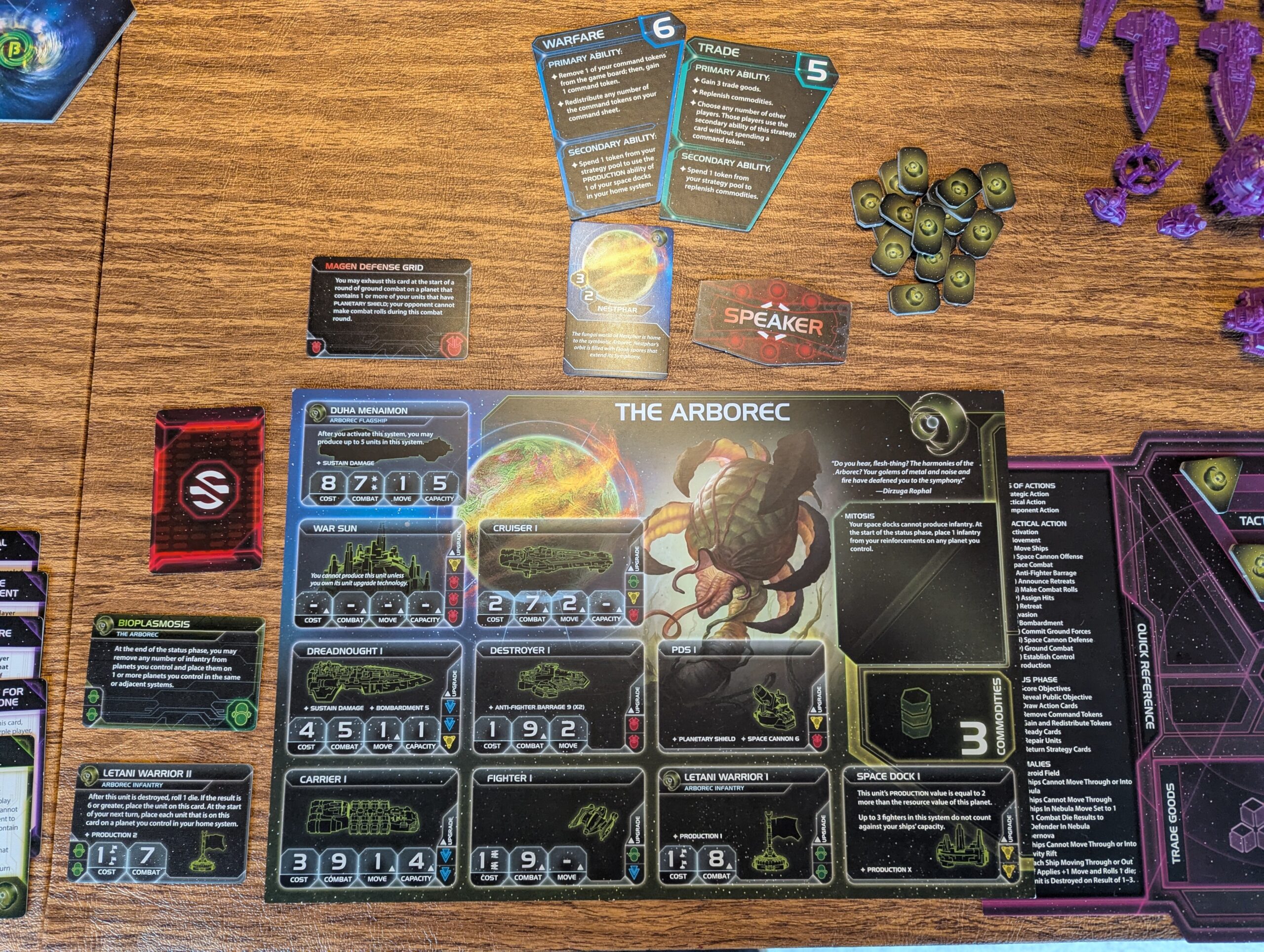
Factions come with their own special abilities and/or limitations as well starting planets, space and ground forces, and technology. They also have Command Tokens which are the most crucial element of the game. Command Tokens get distributed on your player board between your Tactics, Fleet, and Strategy pools. Command Tokens from Tactics are spent to move ships, invade planets, and build more forces. The number of tokens in your Fleet determines how big your individual armadas can be. Finally, tokens from your Strategy pool get spent to unlock abilities from the Strategy Cards.
At the start of every round players will choose 1 or 2 Strategy Cards which determines round order as well as granting access to special abilities like gaining more Command Tokens, researching new Technology, gaining Trade Goods, and more. Whoever picked the card at the start of the round can use the powerful primary ability but other players have an option to spend a Command Token from their Strategy Pool to use a Secondary Ability which often is a smaller version of the Primary one. This mechanic keeps everyone engaged even when it’s not their turn and provides opportunities. Most of these secondary abilities are smaller versions of the primary one but others are not. Take the Warfare Strategy Card. It allows the player who drew it to pick up a Command Token from the board and use it again which provides some strategic flexibility or speed but it lets everyone else produce units in their home systems as a sort of arms race trigger. Thematically it all ties together very nicely. The Strategy Cards are also all numbered and determine the turn order which is often vital to how a round shapes up. Mastering order of operations is key to conquering the galaxy.
After Strategy Cards are acquired and turn order established, players go around in that order either playing those Strategy Cards, using actions from their Action Cards, faction abilities, and tech, or using the Command Tokens to move ships, invade planets, and build units. Command Tokens sit on the board and they limit how often you can activate a planet or the forces present there. Say you want to invade a neighboring system, you would place a Command Token on it and then move any ships in range into that system. If there are any enemy ships, this triggers a space combat and then if you have ground forces and there’s a planet to drop them off on you can do that but once again, if there are any enemies present, you are required to have a ground combat. There is no sharing or peaceful coexistence in Twilight Imperium. Go play Cosmic Encounters for that sort of hippy business. On subsequent turns, that Command Token now present in the system means you cannot activate it again or move any ships there out of that system. It locks everything in place. This is why Warfare is so powerful as it lets you move ships twice which can cause all sorts of anxiety for the rest of the galaxy.
To pay for all the cool things you want to do you need a way to pay for them and there are two main sources – Planets and Trade Goods. Every Planet has two scores, one that represents material Resources and another that represents cultural Influence. Resources are spent to build ships and troops as well as Research. Influence can earn you additional Command Tokens when someone plays the Leadership Strategy Card and is also necessary to bully the guardians of Mecatol Rex into crowning you uhhh liberator. Influence also gets used for voting during the Agenda Phase. To represent using a planet’s Resources or Influence you flip it over. Recently conquered planets start off flipped over so cannot be used until refreshed. Trade Goods are most often acquired through the Trade action although you are able to trade with any neighboring players on either of your turns. They count as wild resources and can be used for either Resources or Influence.
Researching new and exciting technologies is an important part of the game and falling behind as your neighbors get bigger and shinier toys can lead to some lopsided gameplay. When you research, you gain new technology cards which either improve your units or give you additional actions or powers such as faster ships, stronger weapons, more efficient workers, etc. Basic technology can just be researched freely but more advanced ones will come with prerequisites, usually in the form of earlier technologies. Some planets will have a technology symbol on them and can be flipped over to fulfill those prerequisites.
Control of the central planet Mecatol Rex can provide victory points provided you snag the Imperial Strategy Card and indeed a player choosing that at the start of the round is a giant red flag to the rest of the players to unite against their overweening ambitions. To gain control of the galactic capitol you need to have ground forces physically on the planet and to have spent the necessary Influence. This only needs to be spent once and provides a permanent victory point to whoever uncorks the planet. When it subsequently gets conquered and reconquered, no Influence is needed. On the round that it is claimed, the Agenda Phase is added to the game round. This is where players can vote on different laws and resolutions and elections to make their galaxy a more lively place.
While Diplomacy is a physical Strategy Card you can play, its lower case cousin is a vital concept with deep importance for the entire game. Who you attack or trade with is a vital decision that not only impacts you but the whole table. Often times the folks trying to push a combat are not the primary belligerents but their neighbors who hope to profit off the carnage. Every faction is given Promissory Notes that they can offer to try to sweeten deals or discourage aggression. Many of them act as nothing less than hostages being exchanged for good behavior. A twisted quirk of the game is that you can take a Note given by one player and trade it to another which means that if you promise not to attack the lions to focus on the vampires you can very quickly run into those same vampires screwing you over with that same treaty.
After all Strategy Cards have been played and players have no more actions they wish to take, the board refreshes with exhausted planets flipped back over, Command Tokens taken off, new Action cards drawn, and Objectives scored. If the Agenda Phase has been unlocked, players go around voting and horse trading. After all that, if no-one has outright won, a new round begins with more Public Objectives unlocked and the carousel continues.
I will not argue with you that Twilight Imperium is excessively big and unwieldy and remember that this has only been focused on the base game. The expansions add leaders, mechs, exploration opportunities, artifacts, and more more more. It is wildly unbalanced with some factions being much harder to navigate and bring to victory than others. Turns are long and there are so many details to track and frankly you will forget thar you researched an ability that you could have just used or lost track of just who holds your trade agreement Promissory Note. That being said, it is a truly unique and delightful experience given the right company which so far I’ve been lucky to enjoy. It’s an aspirational game that requires logistical foresight and spousal negotiations to bring to the table but when pulled off, is deeply rewarding.